Freeze-Dried Fruit Powder: Uses in Baking, Drinks and Snacks

The fruit flavor in a pink frosting, a mango shake or a coated cereal bite does not always come from fresh fruit. Freeze-dried fruit powder gives food makers another way to work fruit into recipes, with much less water to manage.

The same powder behaves differently in a cake, a drink and a snack coating. Understanding those differences helps bakeries, food brands and manufacturers get better results. This article covers the main uses, practical mixing tips, and the checks that matter when choosing and storing an ingredient.

What Is Freeze-Dried Fruit Powder?

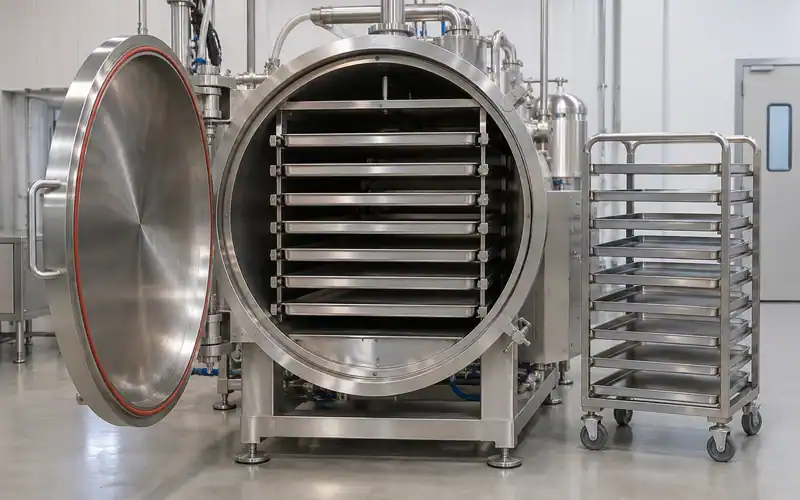
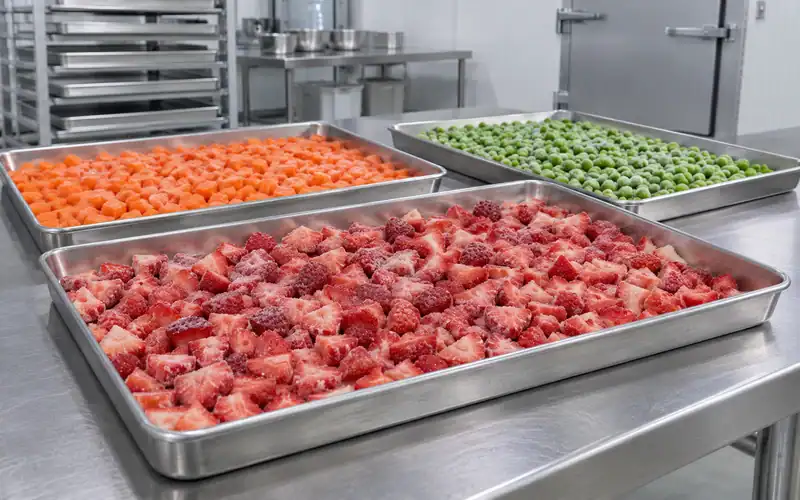
Freeze-dried fruit powder is made by grinding freeze-dried fruit into small particles. During freeze-drying, frozen fruit is placed under vacuum. Most of its water is removed as ice changes directly into vapor. The dried material is then milled to the required size. 

Compared with fruit pieces, powder spreads fruit solids more evenly through a mixture. It supplies flavor and color while adding little water. This makes it useful in dry mixes, frostings and other foods where extra liquid would need careful control.

Its exact composition depends on the fruit and how it is processed. Whole-fruit powder contains fruit solids, including fiber, while some commercial products also contain carriers or other added ingredients.

How to Use Freeze-Dried Fruit Powder in Baking

In baking, fruit powder works in the dough or batter, in a filling, or as a finish. Choosing where to add it helps control how the fruit flavor comes through.

Cakes, Muffins and Cookies

Fruit powder adds flavor throughout a cake or cookie, rather than in separate pieces. Strawberry powder suits vanilla cake, while apple powder pairs with cinnamon in cookies or muffins.

Mixing the powder with the dry ingredients first helps spread it evenly. However, it adds solids and can change how the mixture holds water. The trial batch should be checked for thickness, spread and finished texture before the recipe is scaled up.

Buttercream, Frostings and Glazes

Fruit powder brings fruit flavor to frosting with much less water than juice or purée. Strawberry or raspberry powder, for example, adds a tart note that balances a sweet buttercream.

A fine powder suits smooth finishes. Sifting removes lumps, though it may not remove every small seed or fiber particle. Add it in stages, mix well, and assess the texture after it has had time to absorb moisture. 

Pastry Fillings and Finishing Sugars

Fruit powder can flavor cream fillings or be blended with powdered sugar for dusting. A blueberry glaze on a lemon pastry or a strawberry sugar coating on a doughnut gives the fruit a clear role in the finished product.

For cooked fillings, test the addition point as well as the amount. Adding powder before heating may give a different flavor, color and thickness from adding it later.

Baker adding fruit powder to cake batter

How to Use Freeze-Dried Fruit Powder in Drinks

Fruit powder works in blended drinks and dry beverage mixes. The main challenge is getting an even texture, especially when the finished drink is thin.

Smoothies and Milkshakes

Smoothies and milkshakes are useful starting points because blending helps spread the powder through the liquid. Mango powder can be tested in a yogurt smoothie, while strawberry powder suits a milkshake base.

Allow for the powder’s effect on thickness and tartness. A recipe may need changes to its liquid or sweetener level after the fruit is added. Taste the drink at its intended serving temperature.

Fruit Drinks, Lemonades and Mocktails

In a light fruit drink, small particles are easier to notice. Whole-fruit powders contain fiber and other solids, so some may remain suspended or settle after mixing. Complete dissolution should not be assumed. 

For recipe trials, blend the powder with a small portion of still liquid before adding the rest. Check the drink both immediately and after standing. A cloudy berry lemonade may suit the product concept, while a clear drink needs a different ingredient specification.

Dry Beverage Mixes

Fruit powders can be blended with dry ingredients for drink sachets or smoothie mixes. Here, the powder needs to mix evenly during production and perform well when the customer adds liquid.

Test it using the method stated on the pack. A mix intended for stirring in cold water should be assessed that way; a blender-only trial cannot establish how it performs with a spoon.

How to Use Freeze-Dried Fruit Powder in Snacks

For snacks, fruit powder can flavor the base, blend into a binding mixture, or form part of a surface coating. Each route creates a different eating experience.

Yogurt Snacks and Frozen Treats

Fruit powder blends into yogurt, frozen yogurt and ice cream bases. Strawberry yogurt bark and mango frozen yogurt are two possible product ideas.

It also adds solids that may change thickness and freezing behavior. Research on freeze-dried strawberry powder in dairy desserts found changes in viscosity, hardness and melting. Developers should therefore assess the full texture, rather than judging the recipe by fruit flavor alone. 

Energy Bites, Snack Bars and Granola

Fruit powder can be mixed into the binder used for oat bars, nut-based bites and granola clusters. For example, apple powder could be tested in a cinnamon oat bar, or strawberry powder in a coconut snack bite.

Check how the product holds together after mixing and during storage. The powder supplies fruit flavor, but visible fruit pieces may still be needed when the design calls for distinct bites of fruit.

Chocolate, Coatings and Snack Dustings

A dry fruit powder can be used in chocolate work or as a dusting on coated snacks. Examples include berry-dusted truffles, fruit-flavored white chocolate and cereal bites with a fruit powder coating.

Fine particles matter when a smooth finish is required. In chocolate trials, assess flow and mouthfeel. For dusted snacks, check whether the powder stays on the surface through packing and handling, or collects at the bottom of the bag.

Tips for Using Freeze-Dried Fruit Powder

Reliable results come from measured trials in the actual recipe. Three habits make those trials easier to compare.

Start Small and Measure by Weight

Use a scale to record the addition level. A spoonful can vary with powder density, particle size and how tightly it is packed.

For example, a trial containing 10 g of powder in 1,000 g of total mix has a 1% addition rate. The suitable level still depends on the fruit and recipe. Compare measured amounts while keeping the other ingredients and processing steps consistent.

Choose the Right Mixing Method

The mixing method should match the food. Powder can be preblended with flour or sugar for dry recipes, added gradually to frosting, or dispersed in part of the liquid for a drink.

Water used to make a slurry must be counted in the recipe. For melted chocolate, keep the powder dry and follow the chocolate process; the liquid premixing method used for drinks does not transfer to this application.

Test Texture, Flavor and Color in the Finished Product

Judge the powder after the full process, including baking, cooling or freezing. Heat and acidity can affect fruit pigments, so the color of a raw mixture may differ from the finished food. 

Compare a fresh sample with one kept under the intended storage conditions. Record fruit flavor, color, texture and any settling or clumping. This helps identify changes that a quick tasting would miss.
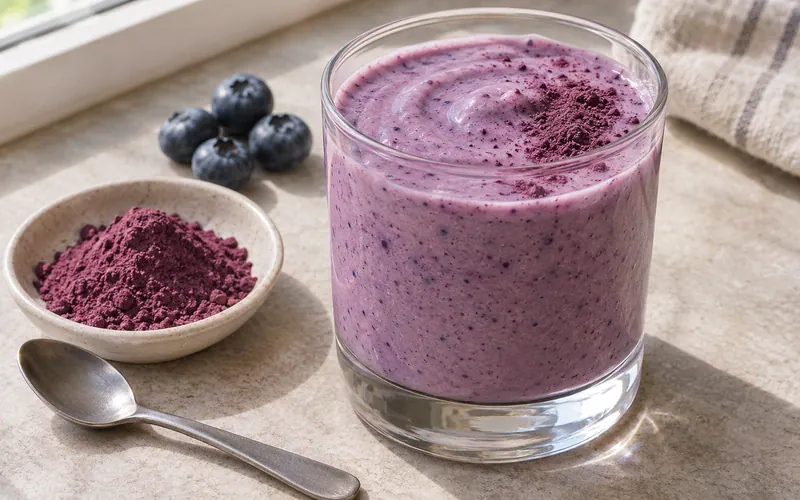
Fruit smoothie with berry powder

How to Choose Freeze-Dried Fruit Powder

Selection starts with the finished food: its flavor, appearance, texture and production method. A powder that works in a snack coating may need a different particle size or mixing process for a drink.

Match the Fruit to the Flavor and Color Needed

Fruit type gives a starting point for product trials. The examples below are application ideas; the final shade depends on the powder, its amount and the recipe.

FruitFlavor and color directionApplications to explore
StrawberrySweet-tart berry flavor; pink to red tonesFrosting, milkshakes, yogurt snacks
BlueberryBerry flavor; purple tones that vary with acidityGlazes, smoothie blends, oat bars
MangoTropical flavor; yellow to orange tonesYogurt drinks, fillings, frozen treats
AppleMild fruit flavor; pale beige to light brown tonesSpiced cookies, granola, cereal bars
Red-fleshed dragon fruitMild flavor; pink to magenta tonesSmoothie bowls, yogurt, dessert finishes

For products led by fruit flavor, assess taste separately from color. Freeze-dried dragon fruit powder, for instance, may provide a stronger visual effect than flavor impact.

FNH’s freeze-dried fruit range is a starting point for exploring fruit options. The required powder format and specification should be confirmed for the intended use.

Check Ingredients and Particle Size

Read the full ingredient list to see whether the product contains only fruit or includes a carrier, sweetener or flow agent. These details affect both recipe performance and the finished label.

Ask for the particle-size specification and test a sample. A powder that feels fine between the fingers may still leave noticeable particles in a smooth drink or chocolate.

Review Bulk Supply, Samples and Quality Documents

When comparing freeze-dried fruit powder suppliers, request a sample alongside the written specification. Useful details include moisture, particle size, microbiological results, pack size and storage guidance. A certificate of analysis, or COA, reports the listed test results for a batch.

For bulk orders, agree on lead times, minimum quantities and acceptable variation between batches. If organic freeze-dried fruit powder is required, confirm that the relevant certification covers the product being purchased. 

How to Store Freeze-Dried Fruit Powder

Freeze-dried fruit powder needs protection from moisture. Exposure to humid air can lead to clumping and poor flow, making the powder harder to weigh and mix.

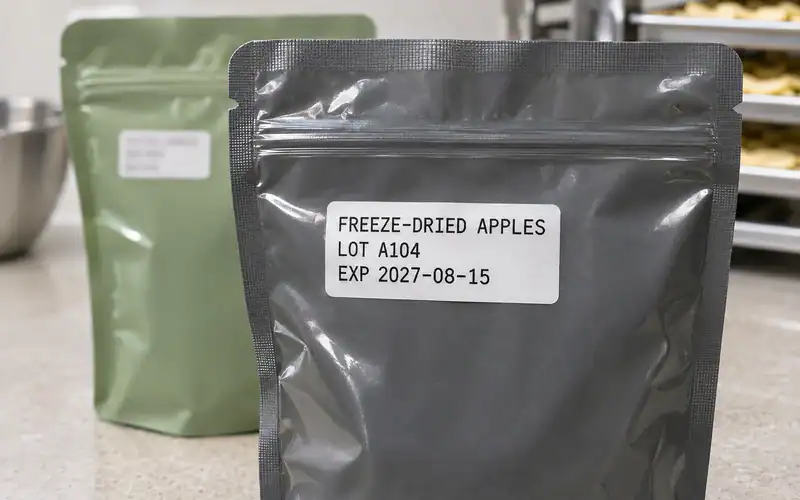
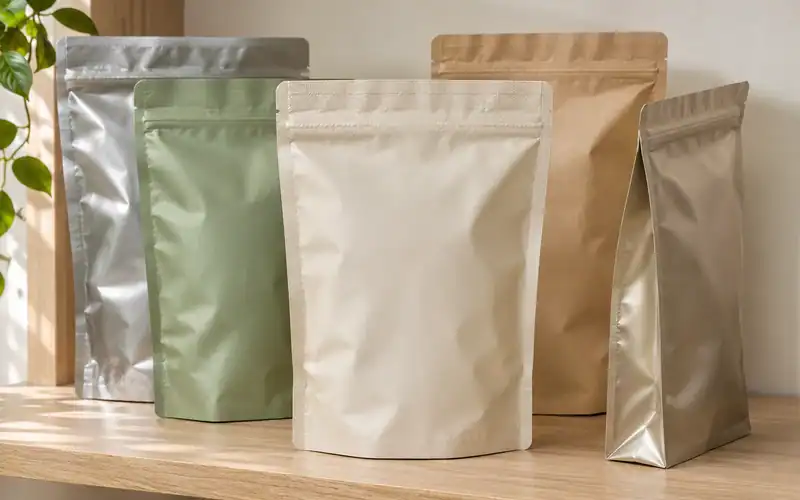
Keep it in well-sealed, moisture-barrier packaging under the supplier’s stated conditions. Store it away from heat and direct sunlight, use dry utensils, and close the pack promptly after taking a portion. Smaller working packs may help when a large bag would otherwise be opened many times.

Follow the product’s shelf-life and after-opening instructions. Once powder is mixed into a drink, yogurt or filling, storage requirements belong to that finished recipe.

FAQs About Freeze-Dried Fruit Powder

Can Freeze-Dried Fruit Powder Replace Fresh Fruit?

Sometimes, but the recipe needs adjustment. Fresh fruit provides water, bulk and texture as well as flavor. Powder is useful where an even fruit flavor is wanted, but it will not recreate pieces of fresh fruit. A direct one-to-one swap by weight is usually unsuitable.

Is Freeze-Dried Fruit Powder the Same as Fruit Juice Powder?

No. The terms describe different aspects of the ingredient. Freeze-dried refers to the drying method; juice powder refers to the starting material. Whole-fruit powder includes fruit solids such as fiber, while juice powder starts with extracted juice. Check both the raw material and the drying method when comparing products.

Can You Make Powder from Freeze-Dried Fruit Pieces?

Yes. Dry freeze-dried pieces can be ground with suitable equipment and sifted to remove larger particles. The powder should then be sealed promptly. For repeat production, controlled milling and a defined particle-size specification help achieve more consistent results.
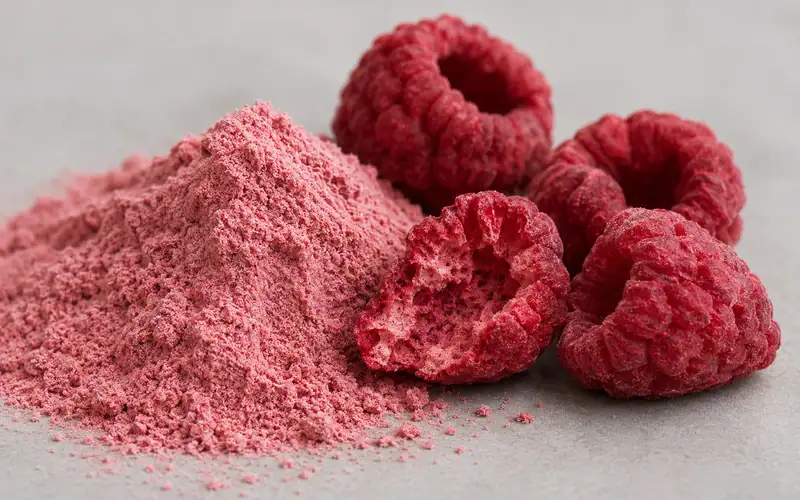
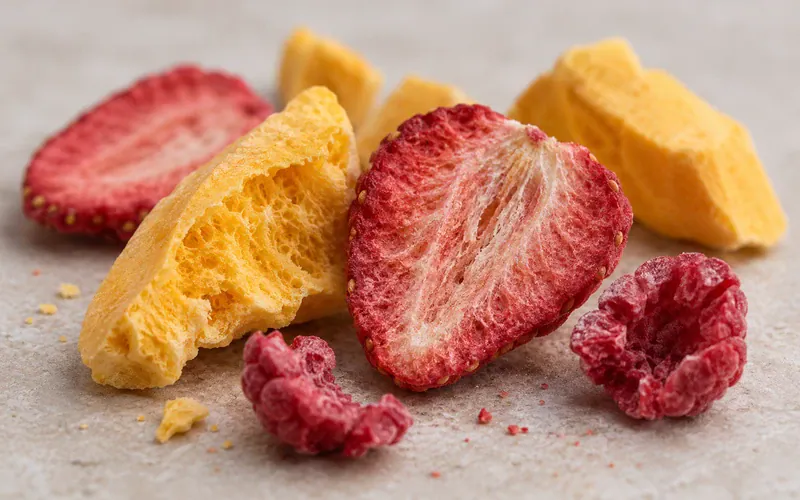
Pink fruit powder beside freeze-dried berries

Conclusion

Freeze-dried fruit powder offers several routes to fruit flavor: mixed through a cake, blended into a drink, or applied to a snack. The most useful choice is the one that performs well through the product’s actual mixing, processing and storage steps.

Businesses exploring a branded freeze-dried food product can review FNH’s private label services and discuss suitable ingredient and packaging options with the team. Begin with the intended application so the available formats can be assessed against the recipe.
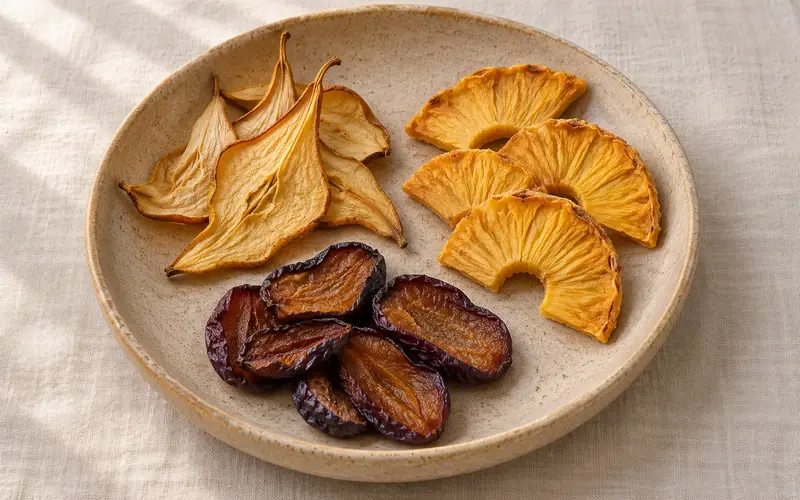
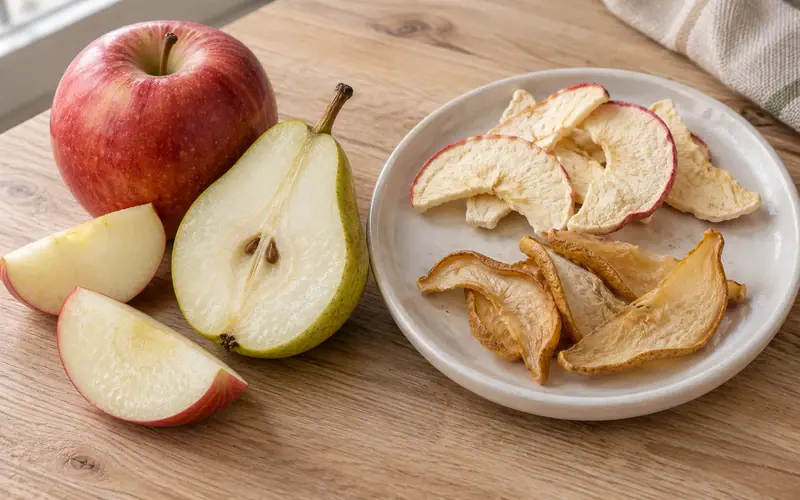
Freeze-Dried vs Dehydrated Fruit: What Is the Difference?

A piece of dried mango may bend and feel chewy, while a freeze-dried strawberry often breaks with a light crunch. Both began as fresh fruit, yet they offer different eating experiences. The difference becomes just as clear when they are added to cereal, a snack bar, or a cake.

Freeze-dried vs dehydrated fruit mainly comes down to how water is removed. The drying method affects texture, flavor, storage needs, and cost. This guide explains those differences and shows how each format can fit a snack, recipe, or food product.

What Are Freeze-Dried and Dehydrated Fruits?

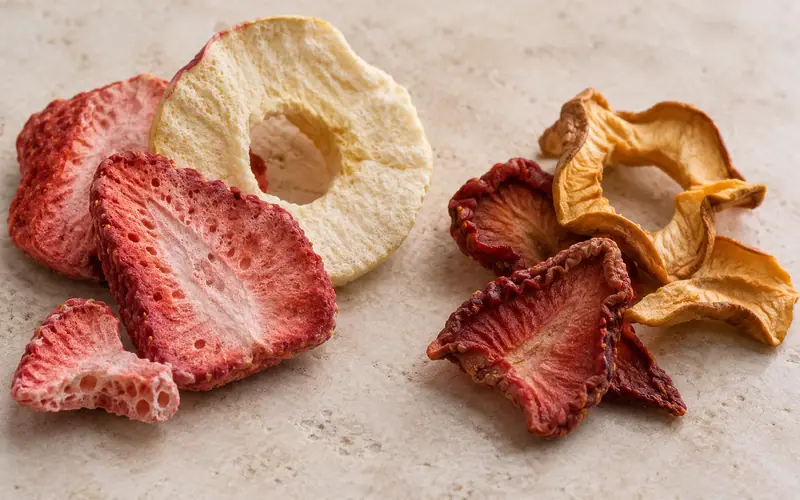
Freeze-dried fruit is fruit that has been frozen and then dried under vacuum. Most of its water is removed while much of its original shape remains. The finished pieces are usually light, porous, and crisp.

Dehydrated fruit is fruit dried by removing water through evaporation. In this guide, the term refers mainly to common hot-air-dried fruit. These products are often smaller, denser, and chewier, though some thin slices can be dried until crisp.

“Dried fruit” is a broad term that can cover several drying methods, including freeze-drying. Product names alone may not explain how the fruit was made.

Freeze-Dried vs Dehydrated Fruit at a Glance

The main differences are easier to see side by side. These are common patterns; fruit variety, piece size, and process settings can change the result.

FeatureFreeze-Dried FruitDehydrated Fruit
Main processFreezing, followed by drying under vacuumWater evaporation, usually with warm air
TextureUsually light, crisp, and fragileOften dense and chewy; some products are crisp
Shape and colorOften keeps more of its original shape and colorUsually shrinks; color may darken
NutrientsCan retain heat-sensitive nutrients wellRetention depends on heat exposure and drying time
RehydrationPorous pieces often take up water readilyOften slower, with more lasting chew
StorageNeeds strong protection from moistureAlso needs suitable packaging and dry storage
CostUsually higherUsually lower
Common usesCrisp snacks, cereal, toppings, and powdersChewy snacks, bars, and baked goods

How Are Freeze-Dried and Dehydrated Fruits Made?

Both methods remove water to help preserve fruit. The key difference is how that water leaves and what happens to the fruit’s structure along the way.

Freeze-Dried Fruit: Freezing and Vacuum Drying

The fruit is prepared and frozen before drying. Under vacuum, ice changes directly into water vapor without first melting. This change is called sublimation. A final drying stage removes more of the remaining moisture.

Freeze-drying uses controlled heat to support drying. The product stays frozen during the main ice-removal stage, so the process differs from drying fresh fruit with warm air.

The spaces left by ice help create a porous structure. This gives many freeze-dried fruits their light weight and crisp bite.

Dehydrated Fruit: Warm Air and Evaporation

During hot-air drying, warm air moves over prepared fruit. Water moves toward the surface and evaporates. As the fruit loses water, its soft structure often shrinks and becomes more compact.

Drying temperature, time, airflow, and slice thickness all affect the finished product. This is why a chewy apple ring and a crisp apple chip can both be made through dehydration.

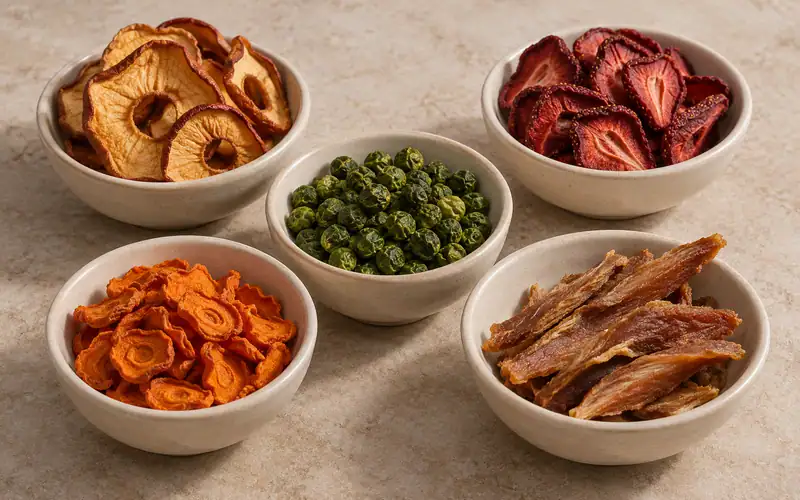
Dehydrated fruit slices in a bowl

Freeze-Dried and Dehydrated Fruit: Texture, Taste, and Color

Texture is often the first difference a person notices. Freeze-dried fruit tends to break easily and soften as it absorbs moisture. Dehydrated fruit often bends and requires more chewing. Neither texture is right for every product.

For example, freeze-dried strawberries can provide a crisp bite in a dry cereal mix. Chewy dried fruit can give a snack bar a different texture. The choice depends on the eating experience the product needs.

Freeze-drying often keeps a brighter color and a flavor closer to the starting fruit. Heat drying can change aroma, color, and sweetness perception. Variety, ripeness, and any pretreatment also matter.

The same porous structure that creates crunch can make freeze-dried pieces fragile. Suppliers and buyers should consider broken pieces and fine particles when choosing a cut size and packaging format.

Is Freeze-Dried Fruit Healthier Than Dehydrated Fruit?

Both formats can provide fiber, minerals, and other fruit nutrients. Freeze-drying can help retain some heat-sensitive nutrients, but a fair comparison also needs to consider the ingredient list and serving size.

How Drying Affects Vitamins and Other Nutrients

Vitamin C and some other fruit compounds can be affected by heat, oxygen, and processing time. Freeze-drying can retain more of these compounds than hot-air drying. For example, a study of three mulberry varieties found better retention of vitamin C and several plant compounds after freeze-drying under the tested conditions. 

That finding does not establish one retention rate for all fruits. Fruit variety, preparation, drying settings, and storage all affect the final nutrient levels.

Finished-product test results give food brands a clearer basis for comparing nutrients. The drying method alone cannot show how much of each nutrient remains.

Natural Sugar, Added Sugar, and Serving Size

Removing water makes the fruit’s natural sugars more concentrated by weight than in fresh fruit. It does not create extra sugar. Both drying methods can produce fruit with no added sugar.

Some products contain added sweeteners, oils, preservatives, or coatings. These depend on the recipe and processing choices. The ingredient list helps identify added sweeteners. Total sugar also includes sugar naturally present in the fruit, so both the ingredients and nutrition label matter.

For a useful comparison, check equal weights as well as the stated serving sizes. Equal-sized handfuls may weigh very different amounts because freeze-dried pieces are less dense.

How Long Do Freeze-Dried and Dehydrated Fruits Last?

Both can have a much longer shelf life than fresh fruit. Freeze-drying often produces very low residual moisture, which can support extended storage when the product is properly packed. However, there is no single shelf life that applies to every fruit or package.

Two measures matter. Moisture content describes how much water is present. Water activity describes how available that water is for microbial growth and other changes. The measures are related, but they are not interchangeable. 

Packaging must help protect the fruit from moisture and other causes of quality loss. Storage temperature, light exposure, seal quality, and the fruit itself also affect how long the product keeps.

Opening the pack changes those conditions. Freeze-dried fruit can absorb moisture from the air and lose its crunch. Dehydrated fruit also needs protection from moisture. Resealing promptly and storing the product in a cool, dry place helps protect quality. The label or supplier’s instructions should guide use after opening. 

For commercial purchasing, the stated shelf life should match the exact product, packaging, and storage conditions being supplied.

Fresh fruit on a wooden table

Why Is Freeze-Dried Fruit Usually More Expensive?

Freeze-drying requires freezing equipment, a vacuum system, a cold condenser, and careful process control. Its drying cycle is often longer than hot-air drying. Equipment, energy, and production time all contribute to the cost.

Fruit quality, cut size, sorting needs, and packaging also affect the quotation. A whole-piece snack may have different requirements from a product intended for milling into powder.

Buyers should compare equivalent specifications. Two prices per kilogram may reflect different moisture levels, ingredients, or proportions of intact pieces.

Freight needs a separate check. Freeze-dried fruit is light, but it can occupy more space and need protection against crushing. Lower product weight does not always mean a lower delivered cost.

Freeze-Dried or Dehydrated Fruit: Which Should You Choose?

The useful starting point is the finished product. Its target texture, moisture level, packaging, and price will help determine which fruit format fits.

For Crunchy Snacks, Cereal, and Dry Toppings

Freeze-dried fruit suits products that need a light crunch and visible fruit pieces. Common uses include fruit snack packs, cereal mixes, and dry dessert toppings.

Contact with yogurt, milk, or other moist foods changes that texture. Adding pieces shortly before serving can help preserve their crunch. In a packaged product, moisture can move from other ingredients into the fruit, so the full recipe needs testing.

Freeze-dried fruit can also be milled into powder for flavor and color. This can be useful where a recipe needs fruit flavor with little added liquid.

For Chewy Snacks, Bars, and Baked Goods

Dehydrated fruit often fits products that need a firmer chew, such as fruit mixes, certain snack bars, and cookies. Its denser structure can also make it less prone to crumbling during handling.

Both formats can work in baking, but they behave differently. Freeze-dried fruit may absorb liquid and soften or break apart. Dehydrated fruit can retain a chewy bite. Replacing one with the other may require changes to liquid levels, piece size, or mixing steps.

For Food Brands and Bulk Buyers

A sourcing brief should define the fruit’s job in the product. Buyers comparing freeze-dried fruits with dehydrated alternatives should check:

Samples should be tested through the intended mixing, filling, and packing steps. This helps show whether the fruit keeps the required appearance and texture under real production conditions.

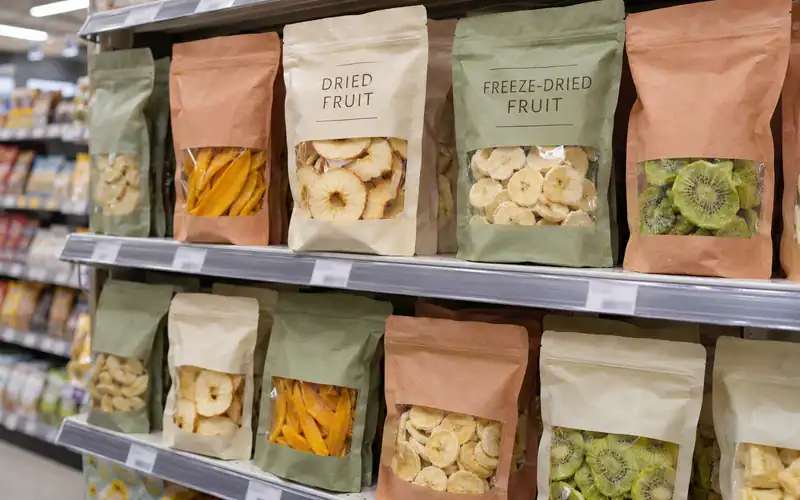
Assorted dried fruit packages in grocery store

FAQs About Freeze-Dried and Dehydrated Fruit

Equipment and recipe choices can raise further questions about how these products are made and used.

Can a Dehydrator Make Freeze-Dried Fruit?

A standard food dehydrator removes water by evaporation. It does not provide the freezing and vacuum conditions needed for freeze-drying. Drying fruit until it is crisp does not make it freeze-dried.

Can Freeze-Dried Fruit Replace Dehydrated Fruit in Baking?

It can work in some recipes, but the swap needs testing. The two products differ in moisture, density, and water absorption. A direct replacement by volume or weight may change the texture and moisture balance of the bake.

Does Freeze-Dried Fruit Need to Be Rehydrated?

Many freeze-dried fruit snacks can be eaten straight from the pack. Rehydration is useful when a recipe needs softer fruit. The time and amount of liquid depend on the fruit and cut size. Rehydrated fruit may not fully regain the texture of fresh fruit.

For manufacturers and buyers, the right choice comes from matching the fruit to the product. Freeze-dried fruit often fits a light, crisp format, while dehydrated fruit often suits a denser chew. The final decision should account for taste, recipe performance, packaging, and cost.

Choosing Between Freeze-Dried and Dehydrated Fruit

Freeze-dried fruit is often a good fit for light, crisp snacks and dry toppings. Dehydrated fruit often works well where a denser chew and lower cost are priorities. The right choice depends on the finished product’s texture, flavor, storage needs, and budget.

For food brands developing a freeze-dried fruit product, a clear brief makes sourcing easier. Buyers can contact FNH Food to discuss fruit types, cut sizes, and packaging needs. Sharing the intended use and target order volume gives the team a useful starting point.

Are Freeze-Dried Fruits Healthy? Nutrition vs Fresh Fruit

A bowl of yogurt can work well with fresh berries or a few crisp pieces of freeze-dried fruit. Fresh fruit adds juice and softness. Freeze-dried fruit is light, easy to store, and ready to use. Both can bring fruit into a meal, but their nutrition labels may look quite different.

Are freeze-dried fruits healthy? Plain versions can be a useful part of a balanced diet. The main points to consider are nutrient retention, natural sugar, and portion size. This guide explains what changes during freeze-drying, how the result compares with fresh fruit, and what shoppers and food brands should check.

Are Freeze-Dried Fruits Healthy?

Plain freeze-dried fruits can be healthy when eaten in suitable portions. They retain fruit fiber, minerals, and varying amounts of vitamins and plant compounds. Removing water makes fruit easier to store and carry, but it also changes how much fruit fits into a serving by weight.

The finished recipe matters. A bag of plain strawberry pieces has a different nutrition profile from strawberries coated in chocolate or mixed with added sugar. Freeze-drying describes the process; it does not define every ingredient in the final product.

For manufacturers and suppliers, a sound nutrition claim depends on the finished product. The fruit type, recipe, and nutrient data should support the claim. A general statement about freeze-drying cannot replace those checks.

How Does Freeze-Drying Change Fruit?

Freeze-drying removes water from frozen fruit under vacuum. During the main drying stage, ice changes directly into vapor. This step is called sublimation. Further drying removes more of the remaining moisture.

The process uses controlled heat to support drying while managing the fruit’s temperature. It avoids the prolonged exposure to hot air used in some other drying methods. These conditions can help preserve color, flavor, and some heat-sensitive nutrients.

As water leaves, it creates small spaces within the fruit. This porous structure gives many freeze-dried pieces their light, crisp texture. It also makes them sensitive to moisture after opening. For fruit producers, careful drying and suitable packaging both affect the quality that reaches the customer.

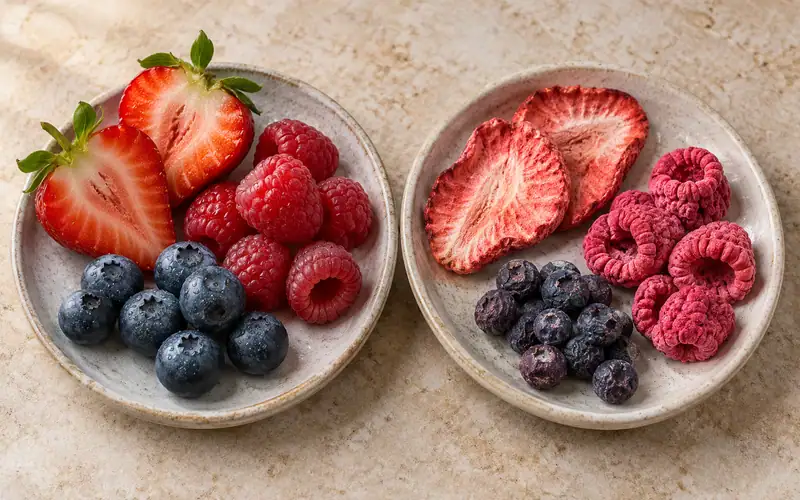
Fresh berries beside freeze-dried berries

What Nutrients Do Freeze-Dried Fruits Retain?

Freeze-dried fruit retains several useful nutrients, but each nutrient responds differently to processing. The fruit itself also matters. Strawberries, blueberries, and bananas start with different amounts of vitamins, minerals, and fiber. The main groups below need to be assessed separately.

Fiber and Minerals

Whole-fruit pieces generally retain their fiber and minerals after freeze-drying. Fiber remains in the fruit’s solid material, while minerals do not evaporate with the water.

However, preparation can change the result. Removing skins, filtering juice, or separating seeds can alter fiber content before drying begins. Plain whole-fruit pieces and a fruit juice powder should therefore be judged on their own nutrition data.

Minerals such as potassium, magnesium, and calcium may remain in the dried fruit. Their amounts depend on the fruit and the portion. Their presence alone does not mean every product is a rich source.

Vitamin C and Other Vitamins

Freeze-drying can preserve vitamin C well compared with some heat-based drying methods, but it does not prevent every loss. Vitamin retention varies with the fruit, preparation, and drying conditions.

A study of blueberries, tart cherries, strawberries, and cranberries found that freeze-drying retained vitamin C better than the other drying methods tested. The results also varied by fruit and nutrient. They do not support a single retention percentage for all freeze-dried fruits. Other vitamins, including B vitamins, need separate checks. 

Fresh fruit is not fixed in nutritional value either. Its nutrients can change after harvest and during storage. The age and storage history of both products matter when comparing them.

Antioxidants and Other Plant Compounds

Freeze-dried fruit can retain plant compounds with antioxidant activity. Examples include anthocyanins, carotenoids, and phenolic acids. Their levels depend on the fruit and the process, and some can decline during drying or storage.

A higher amount per gram of dried fruit may simply reflect water removal. It does not necessarily mean the process created more of a compound. Retaining these compounds also does not prove that a snack prevents disease. Food brands should keep nutrition claims separate from medical claims.

Freeze-Dried Fruit vs Fresh Fruit: A Nutrition Comparison

Fresh and freeze-dried fruit can both provide useful nutrients. The clearest differences are water content and the amount of fruit solids in each gram. This comparison applies to the same fruit without added sugar or coatings.

FeatureFresh fruitPlain freeze-dried fruit
Fiber and mineralsPresent in the fruit’s solidsGenerally retained; amounts per serving vary
VitaminsLevels can change during storageSome losses can occur during processing and storage
Natural sugar per gramLower because water adds weightHigher because much of the water is removed
Calories per gramLower for the same fruitHigher for the same fruit
Water contentContributes water to the dietContains very little moisture

The table shows why equal weights are not always useful for judging a snack. Actual portions need a closer look.

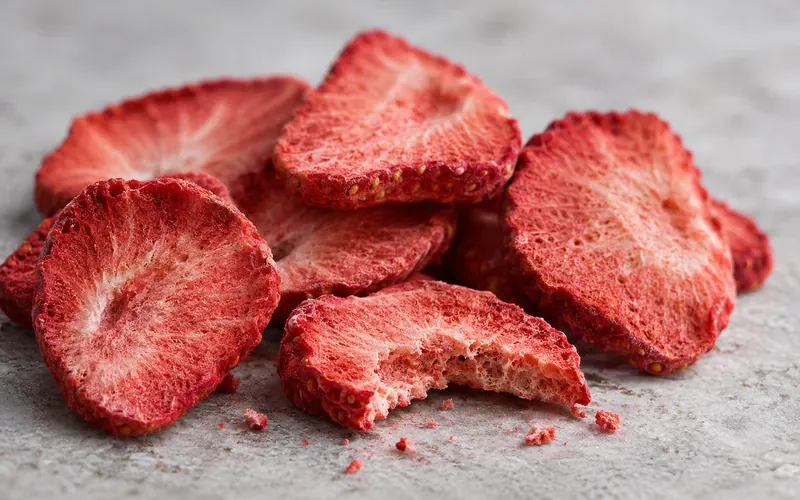
Close-up of freeze-dried strawberry slices

Sugar and Calories: Compare the Right Portions

Removing water concentrates the fruit’s natural sugar and calories by weight. It does not add sugar by itself. A 100g portion of freeze-dried strawberries represents much more original fruit than 100g of fresh strawberries.

Three comparison methods answer different questions. Equal weights show concentration. Equal amounts of original fruit help explain changes caused by processing. The serving actually eaten shows how much sugar and energy enter a meal.

For everyday eating, the last measure is usually the most useful. A small portion of plain freeze-dried fruit can fit into a balanced snack. Eating several portions straight from a large bag can give a different result, even when no sugar has been added.

Water Content and Fullness

Fresh fruit provides much more water than freeze-dried fruit. For the same fruit, this lowers calories per gram and allows a larger portion by weight for a given calorie intake.

That can make fresh fruit useful when a person wants a moist, substantial snack. Freeze-dried fruit offers a dry, crisp option that is easy to carry. How filling either snack feels also depends on portion size and the other foods eaten with it.

How to Choose Healthy Freeze-Dried Fruit

A suitable choice starts with a clear ingredient list and a serving that fits the intended use. Nutrition labels and packaging instructions provide more useful detail than a broad claim such as “healthy fruit snack.” These checks help both shoppers and brands compare products.

Check Ingredients and Added Sugars

For plain fruit, look for the named fruit in the ingredient list. Check any extra ingredients separately. Sugar, syrup, and sweet coatings change the finished product’s nutrition profile.

On a U.S. Nutrition Facts label, Total Sugars includes both natural fruit sugar and any added sugar. Added Sugars identifies the sugar added to the product. A label showing 0g Added Sugars can still show several grams of Total Sugars. The two figures should not be added together. 

The freeze-dried fruit range provides examples of fruit options to consider. For bulk supply, buyers should check the chosen product’s ingredient list and nutrition data before planning a label or health claim.

Read Serving Sizes and Nutrition Labels

Serving weight and servings per package show how the nutrition figures relate to the amount eaten. A light bag can still contain more than one serving.

For example, if a 30g bag lists a 10g serving, the full bag contains three servings. Eating the whole bag gives three times the calories and sugar shown per serving. This is a label-reading example, not a recommended portion for every fruit.

Portion needs vary with the fruit, the meal, and the person. The label provides a reference amount; it is not a personal diet plan.

Check Packaging and Storage Instructions

Sealed packaging helps protect freeze-dried fruit from moisture. Oxygen exposure can also affect some sensitive compounds during storage. Keeping the product protected helps preserve its texture and quality.

Follow the stated storage directions and close the pack after use. A small bowl can help keep the portion clear while the rest stays sealed. There is no single shelf life that applies to every fruit, recipe, and package.

How to Include Freeze-Dried Fruit in a Balanced Diet

Freeze-dried fruit works well as a measured snack or a small addition to a meal. Yogurt, oatmeal, and cereal are simple examples. The amount used should suit the whole meal, including any sugar already present in other ingredients.

Freeze-dried blueberries can add fruit flavor to yogurt or breakfast bowls. Add them just before eating when a crisp texture is preferred; they will soften as they absorb moisture.

For food brands, the same principle applies to the finished recipe. Plain fruit can be a useful ingredient, but the complete snack still needs its own nutrition assessment.

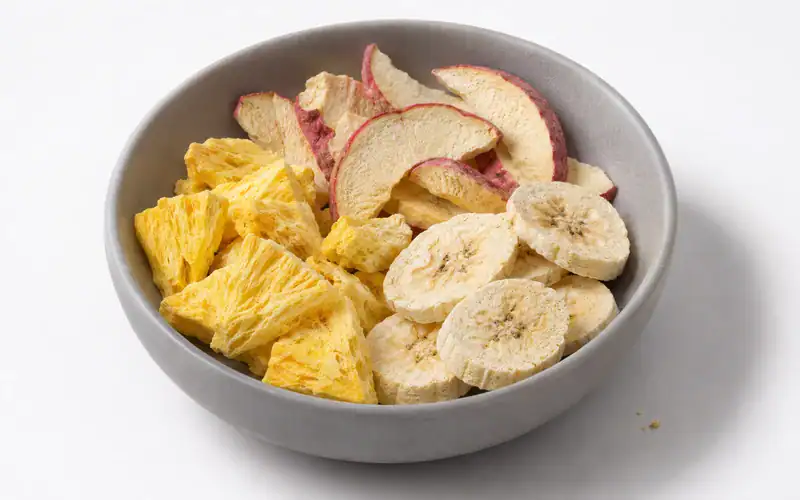
Dried fruit snack bowl on white background

FAQs About Freeze-Dried Fruit

Questions about weight control, fruit intake, and rehydration often come up after the main nutrition comparison. The answers depend on how the product is used.

Are Freeze-Dried Fruits Good for Weight Loss?

They can fit into a weight-management diet, but they do not cause weight loss by themselves. Portion size and total energy intake matter. Fresh fruit may suit someone who wants more food weight for fewer calories, while a measured portion of freeze-dried fruit can be convenient.

Can Freeze-Dried Fruit Count Toward Daily Fruit Intake?

Plain freeze-dried fruit can contribute to daily fruit intake. However, a handful of dried pieces should not be assumed to equal a handful of fresh fruit. Check the serving information and any stated fresh-fruit equivalent. A fruit-flavored snack with only a little fruit is a different product.

Does Freeze-Dried Fruit Need to Be Rehydrated?

Most plain fruit snacks sold ready to eat can be eaten dry. Rehydration is optional when a softer texture suits the recipe. Follow the product’s directions. Adding water changes moisture and texture, but it does not restore nutrients lost during processing.
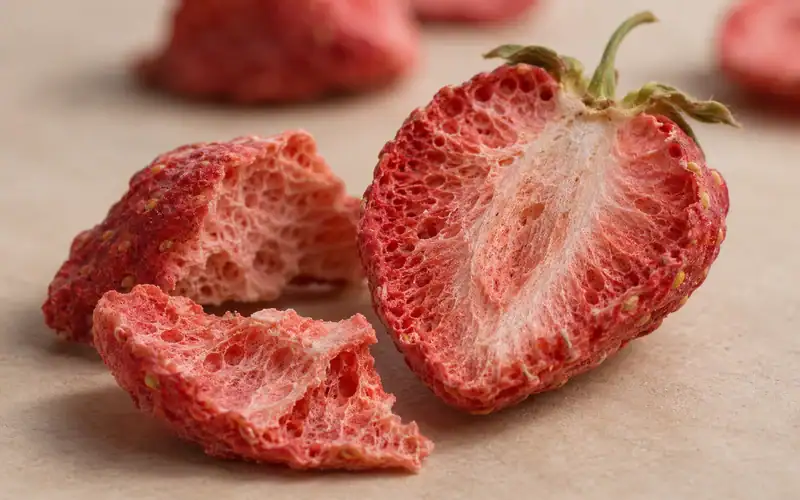
Conclusion: A Practical Complement to Fresh Fruit

Freeze-dried fruits can be a useful part of a balanced diet. They offer fruit nutrients in a light, crisp form, while fresh fruit provides more water and fewer calories per gram. Ingredient choices and portions matter more than a simple ranking of one format over the other.

For food brands, a suitable product should match the recipe, serving size, and packaging needs. FNH Food can be contacted to discuss available fruit options and product specifications. Those details provide a sound basis for choosing an ingredient and describing it accurately.

Freeze-Dried Food Machine: Home Models vs Factory Equipment

A basket of ripe strawberries can be more than a household can finish. A home freeze dryer offers one way to save that extra fruit. A food brand faces a different task: producing the same food, in the right amount, for repeated customer orders. Both use freeze-drying, but their equipment and daily work differ.

A freeze-dried food machine removes water from frozen food under a vacuum. Home models suit smaller batches, while factory equipment supports larger production plans and more detailed process control. This guide compares their output, costs, and operating needs. It also explains what a food business should consider before making products in-house or buying from a manufacturer.

What Is a Freeze-Dried Food Machine?

A freeze-dried food machine, usually called a freeze dryer, combines freezing, low pressure, and controlled heat to remove water from food. It differs from a normal freezer, which keeps food frozen without removing most of its moisture.

The process has three main stages:

  1. Freezing: Water in the food turns to ice. Depending on the system, food may freeze inside the machine or in a separate freezer.
  2. Primary drying: The chamber pressure drops, and controlled heat supplies energy for the ice to turn directly into water vapor. This change is called sublimation. A cold condenser captures the vapor as ice.
  3. Secondary drying: Further drying removes some of the moisture that remains bound to the food after the ice has gone. 

The result is a light, dry product that needs suitable packaging to stay dry. Freeze-drying does not remove all fat or sugar, and it does not replace cooking or other food safety steps.

Home vs Factory Freeze-Dried Food Machines: Key Differences

The main differences are batch size, process control, and the work needed to keep production running. Both types use the same basic drying principle. Their features vary by model, so the labels “home” and “factory” are only a starting point.

ComparisonHome ModelsFactory Equipment
Main purposeHousehold food storage and small trialsPlanned food production and repeat orders
Batch capacitySmaller loads, limited by tray space and water loadLarger loads matched to the product and production target
ControlsOften automatic cycles; settings vary by modelCommonly supports product-specific cycles and process records
Loading and handlingUsually manual preparation and tray loadingMay use larger tray systems, carts, and separate preparation areas
InstallationNeeds a suitable surface, power, ventilation, and pump spaceNeeds site planning for power, cooling, access, and related equipment
Cost focusPurchase price and cost per household batchTotal production cost, usable output, and order delivery

Batch Capacity and Actual Output

Batch capacity must be read with its measurement basis. The weight of fresh food loaded into a machine is different from the weight of finished dry food. Tray area and the amount of water the condenser can capture also limit the load. 

For a simple example, a 20 kg load with 80% water contains 4 kg of dry solids. After most of the water is removed, the finished batch weighs much less than 20 kg. This calculation uses an assumed moisture level, not a machine rating.

Weekly output also depends on loading, drying, defrosting, cleaning, and packing time. A machine that holds enough food for one order may still struggle to support several orders each week.

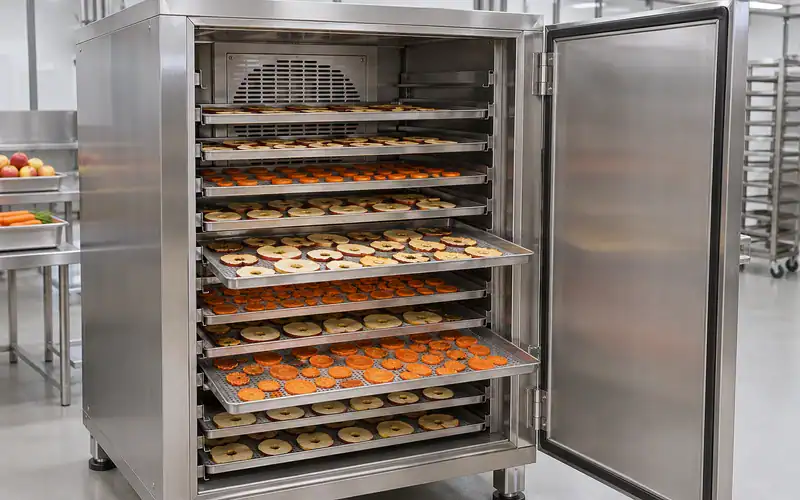
Industrial freeze dryer in food factory

Process Control and Batch Consistency

Factory production needs a drying cycle that gives repeatable results for each product. Shelf temperature, chamber pressure, and drying time all affect the outcome. Process records help the team check whether a batch followed the approved settings.

A home machine may offer automatic programs and adjustable settings, but the range of control differs. A successful home batch can show that a product is promising. Its settings still need testing before use on a larger system.

Consistency also includes the food itself. A brand buying freeze-dried fruits may need even slices for snacks or smaller pieces for cereal. Clear size and texture targets help turn a general product idea into a useful production standard.

Installation and Daily Operation

Home equipment still needs a planned working space. The machine and pump produce heat and noise. The owner must follow the model’s requirements for power, airflow, drainage, and cleaning access.

A factory must also allow for the work around the dryer. Food preparation, tray movement, frozen storage, and packaging need enough space. Power and cooling needs should be checked for the chosen system before installation.

In both settings, the full workflow matters. A drying machine cannot resolve delays caused by slow preparation or a packing area that cannot handle the finished batch.

Equipment Costs and Running Costs

The purchase price is only part of the cost. Electricity, labor, packaging, pump service, and replacement parts contribute to the cost of each batch. The mix of these costs changes with the machine and local operating conditions.

For a business, a useful measure is total production cost divided by the kilograms of saleable finished food. That total should include a share of equipment and facility costs. It should also allow for failed batches and downtime.

A higher-capacity machine may lower some handling costs when it is well used. However, unused capacity still ties up money. Cost comparisons should use expected orders and tested output, rather than a promise of quick payback.

When Is a Home Freeze Dryer a Good Fit?

A home freeze dryer is a good fit when a household regularly has suitable food to preserve and accepts the time and care involved. Common uses include saving garden produce, making lightweight snacks, and storing portions of cooked meals.

The benefit is control over ingredients and batch size. For example, a family can process apples, strawberries, or peas from its own supply. It can also choose portions that fit its normal use.

However, preparing food, cleaning trays, checking dryness, and sealing packages remain manual tasks. Pump maintenance depends on the pump type. A machine with an automatic cycle still needs an owner who follows food handling and storage guidance. 

For a food business, small equipment may help with early product trials. It should not be treated as proof that the same recipe will meet larger orders. The business still needs to confirm its process, output, and sales requirements.

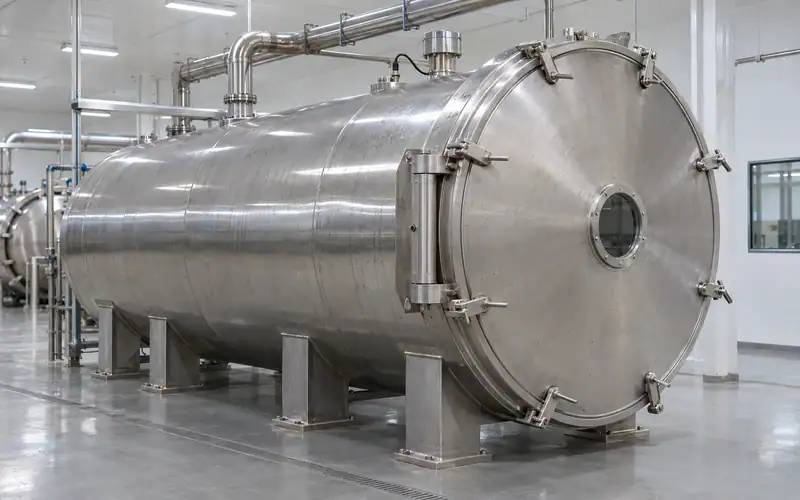
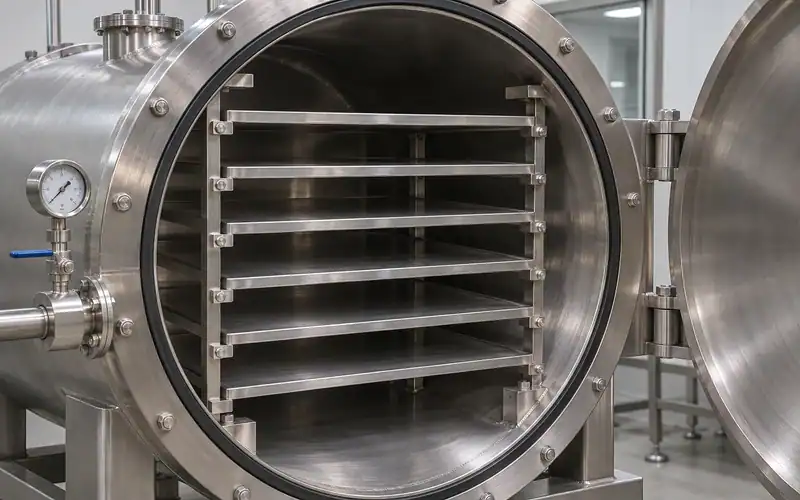
Stainless steel freeze-drying equipment

What Does Factory-Scale Freeze-Dried Food Production Require?

Factory-scale production needs a controlled food process from incoming ingredients to sealed packages. The freeze dryer is one part of that process. Repeat orders depend on consistent preparation, suitable drying cycles, and checks on the finished food.

Food Preparation and Product-Specific Drying Cycles

Preparation must match the food and its intended use. Washing, cutting, and cooking may be needed before freezing. Uniform pieces and even tray loads help reduce differences within a batch.

A strawberry slice, a carrot cube, and a portion of prepared soup have different drying needs. Thickness, water content, and the recipe affect how water leaves the food. Manufacturers should test representative loads before setting a routine production cycle. 

The aim is to reach the required dryness while keeping the desired structure and texture. Shortening a cycle is useful only if the finished product still meets those targets.

Food Safety Checks and Batch Records

Freeze-drying is not a reliable step for killing harmful bacteria. Safe raw materials, clean equipment, and suitable handling remain essential. Foods that require cooking need an appropriate cooking or other validated safety step. 

Manufacturers also need product checks that support their release standards. These may include moisture testing, water activity testing, and relevant microbial tests. The exact plan depends on the food and applicable requirements.

Moisture content measures the amount of water in a food. Water activity describes how available that water is for microbial growth and other reactions. They are related measures, but one does not replace the other. 

Batch records link ingredient lots, process settings, and test results. This helps the team review a problem and identify the food affected.

Packaging and Storage After Drying

Packaging must protect the dry food from moisture entering again. Depending on the product, it may also need to limit oxygen exposure. Suitable barrier materials and sound seals help protect quality during storage and transport.

After drying, the product should be packed promptly under suitable conditions. A good drying result can be lost if the food sits in humid air or the package seal fails. 

Shelf life depends on the food, remaining moisture, packaging, and storage conditions. It should be supported by product-specific evidence. Machine size alone cannot establish how long a food will remain suitable for sale.

Make Freeze-Dried Food In-House or Buy from a Manufacturer?

In-house production makes sense when a business has enough demand and the resources to manage the full process. Buying finished products may be more practical when the main need is a reliable food supply. The choice should account for both production work and business priorities.

When In-House Production Makes Sense

Owning equipment can suit a business with steady orders, suitable space, and a trained team. It may also help when frequent product trials or control over the production schedule are central to the business.

Before investing, the team should confirm actual output with its own food. It also needs a plan for maintenance, quality checks, and production delays. These tasks continue long after the machine arrives.

When Buying Finished Products Makes Sense

Buying from a manufacturer can suit a brand that wants to focus on product sales, retail distribution, or recipe development. It reduces the need to build and operate a drying facility, though supplier checks are still necessary.

For example, a soup brand may need freeze-dried vegetables such as carrot, corn, and pea. Its buying specification can define piece size, moisture limits, pack format, and expected order volume.

Buyers should compare samples with that specification. They should also review test documents, minimum order quantities, lead times, and packaging options with the supplier. Clear food specifications make supplier comparisons and sample reviews more useful.

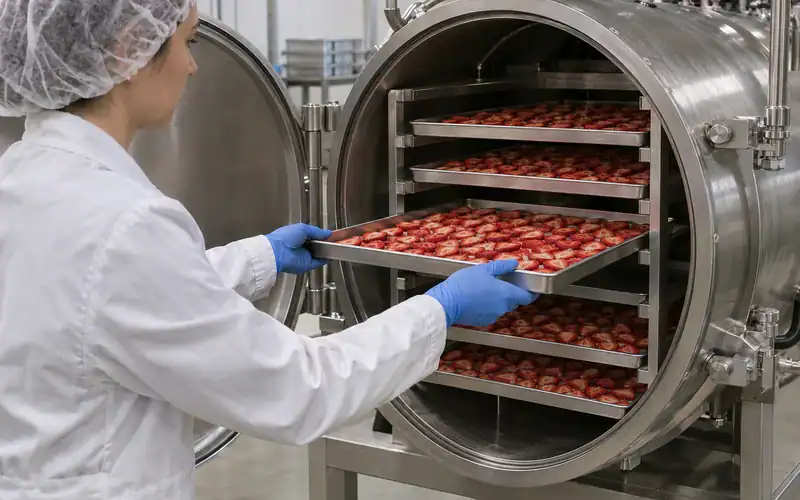
Food trays loaded into a freeze dryer

FAQs About Freeze-Dried Food Machines

The following questions address common doubts about equipment, food types, and small-scale production.

Can a Regular Freezer Make Freeze-Dried Food?

No. A regular freezer can pre-freeze food, but it cannot run a controlled vacuum freeze-drying cycle. It lacks the vacuum and vapor-capture system used by a freeze dryer. Freezer burn is not a substitute for controlled freeze-drying.

Can a Home Freeze Dryer Be Used to Make Food for Sale?

It may be possible, depending on local rules, the food type, and the production setup. Some small food businesses use compact machines. Owning one does not establish that the premises or products meet sales requirements. The business must check those requirements before selling. 

Does a Larger Freeze Dryer Always Dry Food Faster?

No. A larger machine usually holds more food, but batch time depends on product thickness, loading, heat transfer, and system performance. It may deliver more food over a week without finishing each batch sooner. Comparisons should use the same product and a clearly defined load.

Which Foods Are Difficult to Freeze-Dry?

Very oily foods and some high-sugar foods can be difficult to process. Pure oil contains no water for the machine to remove. Syrups and sweet mixtures may need special preparation or cycles to avoid sticky or collapsed products. Mixed foods should be tested as complete recipes. 

Match the Production Method to Your Needs

A home freeze dryer suits smaller preservation tasks when the owner can manage preparation, drying checks, and packing. Factory equipment supports larger production needs, alongside tested processes and quality controls. In either case, useful output matters more than the machine’s label.

For food brands, the decision should start with the required product, order volume, and delivery plan. FNH Food supplies freeze-dried fruits, vegetables, and prepared foods. Brands can share their product requirements with FNH Food to discuss suitable food options and packaging needs.

How to Rehydrate Freeze-Dried Food: Water, Time and Texture Tips

Freeze-drying removes almost all water from food while keeping its shape and cell structure largely intact. What remains is a porous product that absorbs liquid quickly once water is reintroduced. Rehydration is the step that restores that water, and the result depends on three variables: how much water is added, what temperature it is, and how long the food is left to absorb it. Different foods respond differently, so a single fixed method rarely suits every product. This guide explains why absorption rates vary, how water ratio and temperature affect the final texture, how hot and cold rehydration compare, and what separates precooked freeze-dried products from raw ones.

Why Does Freeze-Dried Food Rehydrate So Quickly?

Freeze-dried food is a porous product whose internal structure remains largely intact after sublimation removes its water. The empty spaces left behind draw liquid in rapidly by capillary action, which is why most items absorb water within minutes rather than requiring long soaking.

Absorption speed is driven by three physical factors: density, piece size, and water temperature. Buyers who understand those factors can predict how a product will behave in a kitchen, a production line, or a retail pack.

Porous Structure and Water Absorption

During freeze drying, ice inside the food turns straight into vapour. The solid parts of the food stay in place, so the finished piece keeps its original outline with air pockets where ice used to be. That open network is often called a porous matrix.

Rapid freezing before the drying stage keeps ice crystals small. Small crystals leave fine, even pores, which rehydrate uniformly. Large crystals tear cell walls and produce patchy absorption and soft spots after water is added. This is why freezing speed is treated as a critical control point in a freeze dryer operation.

Absorption Rates by Food Type

Thin, low-density pieces take on water fastest. Dense, thick pieces take longest.

Food typeTypical rehydration time
Leafy greens, herbsAbout 2 minutes
Freeze-dried fruit slices, berries5 to 10 minutes
Freeze-dried vegetables (dices, peas, corn)5 to 15 minutes
Cooked meat pieces, dense proteinsUp to 40 minutes

Piece size explains much of the spread. A 6 mm dice absorbs water far faster than a 15 mm chunk of the same vegetable, which is why uniform cutting is a sourcing specification, not a cosmetic detail. FNH supplies freeze dried vegetables in whole pieces, slices, chunks, dices, granules, and powders so buyers can match format to the required soak time.

Moisture Sensitivity Before Use

The same porosity that makes rehydration fast also makes freeze-dried ingredients sensitive to humid air. An opened bag left uncovered pulls moisture from the room, and pieces lose their crisp snap within hours.

Partial moisture pickup damages texture before cooking even starts. Storage in sealed, moisture-barrier packaging with the air removed protects both crispness and rehydration performance.

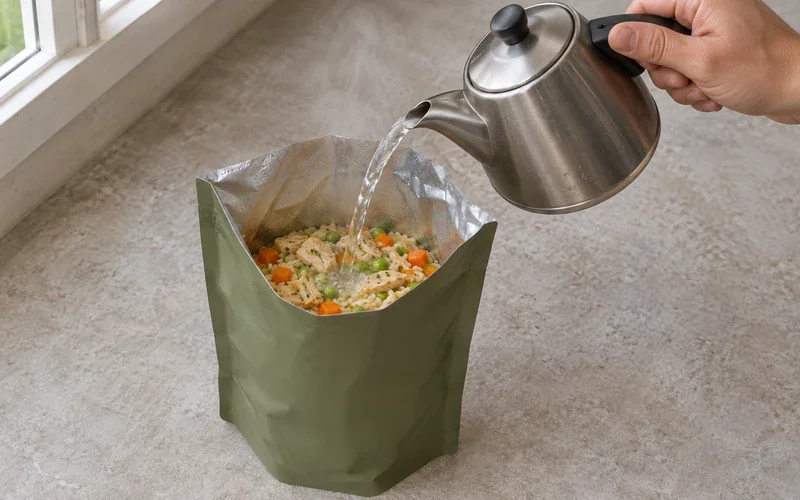
Pouring hot water into an instant meal pouch

How Much Water Is Needed to Rehydrate Freeze-Dried Food?

General industry guidance places most freeze-dried food between a one-to-one and two-to-one water-to-food ratio by volume, with denser meals and powders needing the higher end. Package instructions take precedence, since ratios vary by product and preparation method.

Water volume controls whether the finished product is firm, soft, or waterlogged. The safest working method is to start low and correct upward.

General Water Ratio Ranges

These ranges apply by volume, measured before water is added:

Grains and pasta expand well beyond their dry volume, so the container should be sized for the finished portion.

Adding Water Gradually

Adding all the water at once is the most common cause of a soupy result. Pouring in roughly three-quarters of the target volume, stirring, waiting, then topping up gives a correctable process.

Under-hydrated food is easy to fix with another spoonful of water. Over-hydrated food requires draining, uncovered resting, or a short sauté to drive off moisture, and the texture rarely returns to where it should be.

Adjusting for Dense Meals and Powders

Complete meals contain mixed densities in one pack. Rice, meat, and vegetables absorb at different rates, so these products need the higher ratio plus a stir partway through to move water toward the slowest pieces.

Powders behave differently again. A freeze-dried fruit or vegetable powder disperses into liquid rather than swelling, so it is dosed as a percentage of the recipe. Whisking the powder into a small amount of liquid first prevents lumps before the rest is added.
What Water Temperature and Soaking Time Work Best?

Warm to hot water speeds absorption and suits meats and complete meals, while cool or room-temperature water gives better control over delicate items. Most foods need several minutes to around fifteen minutes, with stirring partway through to even out moisture.

Temperature changes both the speed of uptake and the firmness of the finished piece. Time then does the rest of the work.

Temperature Effects on Speed and Texture

Hot water moves into the porous structure faster and softens plant cell walls at the same time. That helps meats and starches, and it can push delicate fruit past pleasant firmness into mush.

Water temperatureBest suited toEffect
Boiling / near boilingStews, soups, pasta, rice, meat, eggsFastest, softest result
Hot (not boiling)Peas, corn, green beans, oatmealFast with texture retained
WarmMost vegetable dicesBalanced speed and bite
Cool / room temperatureFreeze-dried fruit, yoghurt pieces, herbsSlowest, firmest, most control

Boiling water applied directly to fine slices of freeze dried fruit breaks down structure quickly, so cooler water is the standard choice for fruit that needs to hold its shape in a bowl or on a dessert.

Typical Soaking Time Ranges

Leafy greens finish in about 2 minutes. Fruit and vegetables sit between 5 and 15 minutes. Dense cooked meat can take up to 40 minutes in hot water, and raw meat in cold water may need several hours or an overnight rest in refrigeration.

Covering the bowl or pouch keeps heat in and shortens the wait. A stir at the halfway point redistributes liquid and prevents dry pockets at the base of the container.

Signs of Incomplete Rehydration

A test piece taken from the centre of the batch is the practical check. Cutting it open shows whether the middle is still dry, chalky, or lighter in colour than the outside.

Other signals include a crunchy core inside a soft exterior, pieces floating on top of the water without sinking, and free water sitting in the bowl while the food stays firm. Each of these calls for more time, a stir, or slightly warmer water.

How Does Rehydration Affect Texture and Flavor?

Rehydrated freeze-dried food generally resembles cooked rather than fresh food, since the original cell structure has been dried and refilled with water. Flavor, color, and aroma are largely retained, making the result well suited to soups, baked goods, and prepared dishes.

Texture expectations should be set before a product is specified for a menu or a retail line. Flavour and colour performance, by contrast, remain close to the original material.

Texture Expectations After Rehydration

Rehydrated peas, corn, and diced carrot come back close to their cooked state, with a soft bite and full shape. Meat returns to the texture of cooked meat, tender at the edges and firmer in the middle if soak time is short.

Fruit behaves less predictably. Berries and sliced fruit soften and hold moisture well, yet the crisp snap of fresh fruit does not return. Products used in soups and stews benefit from this, since the softened texture blends into the dish.

Flavor, Color and Aroma Retention

Freeze drying works at low temperature, so heat-sensitive aroma compounds survive the process better than in hot-air drying. Colour stays close to the original, which is why freeze-dried strawberry pieces keep a bright red in a finished bakery product.

Flavour concentrates in the dry state and returns to normal intensity once water is added. Rehydrating in broth, stock, or milk carries additional flavour into the porous structure, a useful technique for foodservice preparation.

Upstream Factors Behind Consistency

Repeatable rehydration begins in the plant. Freezing rate, uniform piece size, consistent slice thickness, and controlled final moisture all decide how a batch behaves in the kitchen.

FNH uses 20 testing stages to maintain stable product quality, including microbiological testing for total aerobic plate count, E. coli, and Salmonella species, along with taste-panel and sensory evaluations at stages of production. For buyers, requesting the cut specification and a sample soak test is the practical way to confirm that batches will perform the same way each time.

Instant meal soaking in hot water

How to Prepare Different Types of Freeze-Dried Food?

Preparation varies by category. Fruits and thin vegetables absorb water quickly and can often be eaten dry, meats need warmth and time to reach the center, and precooked soups and meals are designed to be rehydrated directly before serving.

Matching method to category avoids the two common failures: mushy fruit and cold, hard centres in protein.

Prepare Fruits and Vegetables

Freeze-dried fruits work well without any water at all in cereals, snack mixes, and bakery toppings. When softening is wanted, cool water for 5 to 10 minutes gives fruit that holds its shape.

Vegetables split by density:

Adding freeze dried vegetables directly into a soup or stew removes the separate soak step. The recipe liquid should be increased by roughly one cup for each cup of dry ingredient to cover what the pieces absorb during cooking.

Rehydrate Meat and Dense Items

Freeze dried meat needs both heat and patience. Cooked meat pieces take 20 to 40 minutes in hot water, and the pieces should stay fully submerged for the entire soak.

The centre check is the control step. A piece cut from the middle of the batch should be soft throughout with no dry core. Freeze-dried raw meat must be cooked after rehydration to a safe internal temperature, verified with a probe thermometer rather than by appearance.

Handle Precooked and Raw Products Differently

Precooked items, including freeze-dried soups and complete meals, are ready to eat once water is added and the soak time has passed. No further cooking is required, though a short simmer improves texture in rice and pasta dishes.

Raw products are a different category. Raw meat, raw egg, and raw dough ingredients return to their raw state after water is added and carry the same handling rules as fresh raw food. Product labels state which category applies, and buyers should confirm the product state on the specification sheet before writing preparation instructions.

What Are the Pros and Cons of Rehydrating Freeze-Dried Food?

Rehydration restores freeze-dried food to a usable state within minutes while retaining flavor, color, and aroma. Limitations include texture closer to cooked than fresh food, sensitivity to excess water and high heat, and the loss of shelf stability once liquid is added.

Both sides of that balance affect menu design, portion control, and kitchen workflow.

Main Advantages

Speed is the clearest benefit. Complete meals reach serving condition in 10 to 15 minutes with no chopping, thawing, or trimming, which cuts labour in foodservice and catering settings.

Other operational gains include:

Practical Limitations

Excess water is difficult to reverse. Once a batch is waterlogged, draining removes flavour along with the liquid, and the texture stays soft.

High heat applied to delicate items causes collapse. Fine fruit slices and leafy greens lose structure in boiling water. Rehydration also takes real time for dense proteins, which needs to be built into service timing rather than treated as instant.

Handling and Storage Impact

Shelf stability ends the moment water is added. Rehydrated food is treated as fresh, perishable food from that point and follows normal food safety rules for holding temperature and time.

Dry product should stay sealed between uses. Resealing bags, using desiccant where supplied, and keeping stock away from steam and heat sources protect the porous structure until the product is needed.

Hot Water vs Cold Water Rehydration: Which Method Is Better?

Hot water rehydration is faster and suits meats and complete meals, while cold water works more slowly but gives greater control over texture and is preferred for fruits and heat-sensitive items. Neither method is universally better; the food type decides.

Both methods reach full rehydration. The difference lies in speed, texture control, and whether a heat source is available.

Introducing Hot and Cold Rehydration

Hot rehydration uses water between hot tap temperature and boiling. It drives liquid into the porous structure quickly and softens cell walls at the same time, which is what dense proteins and starches need.

Cold rehydration, sometimes called cold soaking, uses room-temperature or chilled water over a longer period. It requires no stove or fuel and is the standard approach where heat is unavailable or where firm texture is the goal.

Comparing Key Differences

CriteriaHot waterCold water
Speed5 to 15 minutes30 minutes to overnight
Texture resultSofter, cooked-likeFirmer, more defined
Best forFreeze-dried meat, complete meals, rice, soupsFreeze-dried fruit, yoghurt pieces, herbs
Heat source neededYesNo
RiskCollapse of delicate piecesDry centres if rushed

Choosing Between Hot and Cold Water

Hot water is the correct choice whenever the product contains protein, rice, pasta, or a mixed complete meal. Those items need both moisture and warmth to reach an acceptable centre.

Cold water suits fruit destined for desserts, yoghurt, or garnish work, where a defined edge is wanted. Warm water sits between the two and handles most vegetable dices well. Kitchens running both methods should record the water temperature and soak time that produced the best result for each product code, then reuse those settings for consistency.

Frequently Asked Questions

Which freeze-dried foods can be eaten without rehydrating?

Freeze-dried fruits, berries, vegetable crisps, and many snack formats are ready to eat straight from the pack. Their crisp texture is a feature in cereals, trail mixes, and bakery toppings. Precooked meals and dense proteins require water before serving.

Can broth or milk be used instead of water?

Broth, stock, milk, and fruit juice all work in place of water and carry extra flavour into the porous structure. Thicker liquids such as milk absorb slightly more slowly, so a few additional minutes may be needed. The same volume ratios apply.

How long does rehydrated freeze-dried food keep?

Shelf stability ends once liquid is added, and the product becomes perishable. Rehydrated food should be treated like any fresh prepared dish: held hot above safe holding temperature, or refrigerated and used within a day or two, following local food safety rules.

Why does freeze-dried meat stay hard in the center?

Hard centres come from short soak times, water that is too cool, or pieces that were not fully submerged. Dense cooked meat can need up to 40 minutes in hot water. A test piece cut from the middle of the batch confirms whether the centre is done.

How should brands evaluate rehydration performance when sourcing freeze-dried food?

Buyers should run a sample soak using the intended water ratio, temperature, and time, then cut test pieces to check the centre. Recording results in a batch log across several lots reveals whether piece size and drying control are consistent, which is what makes rehydration repeatable in production.

Conclusion

Rehydration comes down to three controllable variables: water volume, water temperature, and time. General ratios and timings offer a useful starting point, but food type determines the result, so package instructions and gradual water addition remain the most reliable approach. Hot water suits meats and complete meals, while cool water gives better control over fruits and heat-sensitive items. Texture after rehydration is closer to cooked than fresh food, and that expectation shapes how each product is best used. For food brands and foodservice buyers, consistent rehydration reflects upstream manufacturing control as much as preparation technique. Further details on available freeze-dried products are available from FNH.

How to Store Freeze-Dried Food: Simple Packaging and Storage Tips

Freeze-drying removes nearly all moisture from food while preserving its shape, color, flavor, and nutritional value. What remains is a light, porous product that absorbs moisture and oxygen from the surrounding air far more readily than fresh or dehydrated alternatives. Storage, then, determines how long that quality actually lasts.

Packaging material, oxygen control, sealing method, and storage environment each play a distinct role, and a weakness in any one of them can shorten shelf life considerably. This guide explains what causes freeze-dried food to degrade, which packaging materials help prevent it, how a reliable storage process works, and how two common packaging methods compare for different storage goals.

Why Does Freeze-Dried Food Need Special Storage?

Freeze-dried food is a shelf-stable product that has had almost all of its water removed through sublimation, leaving a porous internal structure. That structure absorbs ambient moisture and oxygen quickly, so packaging must actively block air, humidity, light, and heat to preserve quality.

Moisture, oxygen, light, and temperature act on the product in different ways. Each one has its own control measure.

Moisture Sensitivity After Freeze-Drying

Freeze-drying removes over 95% of the moisture in food. Removing that water makes the dried product highly hygroscopic, meaning it pulls water vapor out of the surrounding air with little resistance.

When moisture is reabsorbed, microbial activity that was halted by dryness becomes possible again, and spoilage risk returns. The relationship is direct: the more water removed, the stronger the product’s tendency to reabsorb it, so packaging must actively block moisture re-entry rather than merely cover the food.

A barrier film with an intact seal is the practical answer. Any gap in that barrier allows humidity to reach the product continuously throughout the storage period.

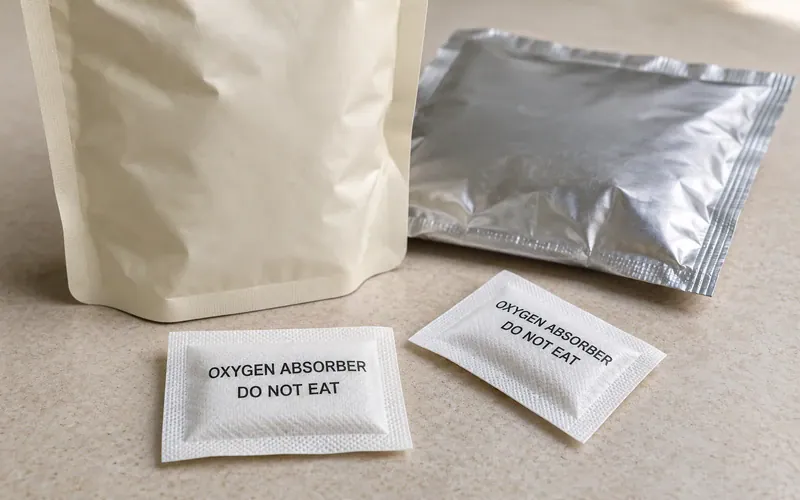
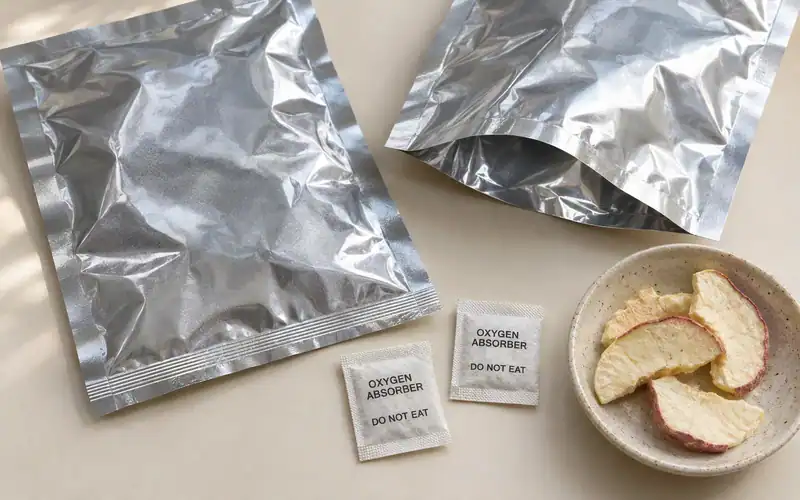
Oxygen absorber packets beside food pouches

Oxygen and Light Exposure

The porous structure left behind by sublimation creates a much greater air-contact surface area than solid or dense dried foods. Oxygen reaching that surface oxidizes fats and nutrients, changing flavor and lowering nutritional value.

Light adds a second pathway of loss, degrading vitamins and flavor molecules over time. Because more surface area is exposed per unit of product, oxidation and quality loss progress faster in freeze-dried food than in denser preserved foods.

That’s why oxygen and light control are treated as packaging requirements rather than optional extras. Sealed freeze dried fruit with a high fat or vitamin content shows these effects most clearly.

Temperature Effects on Shelf Life

Storage temperature has a measurable effect on how long quality holds. Shelf life roughly halves with each 10°F increase in storage temperature, because higher temperatures accelerate the chemical reaction rates behind oxidation, color change, and nutrient loss.

Cool storage below normal room temperature is therefore preferable for both retail stock and bulk inventory. Warm storage areas shorten usable life, even when packaging remains sealed and undamaged.

What Packaging Materials Work Best for Freeze-Dried Food?

Metalized mylar bags combined with oxygen absorbers are the packaging standard for freeze-dried food, because the film blocks oxygen, moisture, and light simultaneously. A heat seal then closes the barrier, while the absorber removes the residual oxygen trapped inside the package.

Film composition, absorber capacity, and seal quality each contribute to the finished package. Secondary containers protect the whole assembly from physical damage.

Mylar Barrier Properties

Metalized polyester film blocks oxygen, moisture, and light at the same time, which is why it forms the base layer of most long-term freeze-dried packaging. Standard polyethylene bags are much more oxygen-permeable, allowing gradual air migration into the package.

Window panels weaken light protection, since the clear section admits the light the metalized layer would otherwise block. Barrier performance is what separates packaging suitable for long-term storage from packaging meant only for short-term handling and quick turnover.

Oxygen Absorber Function and Sizing

Oxygen absorbers consume residual oxygen inside a sealed package through iron powder oxidation. They begin reacting immediately on exposure to air, so open packets lose capacity while they sit out.

Freeze-dried food’s airy structure requires greater absorber capacity than an equally sized quantity of dehydrated food, because more air voids exist per unit of volume. Absorber sizing should follow package volume, not food weight, since trapped air rather than product mass determines how much oxygen must be removed.

Sealing and Secondary Containers

Impulse heat sealers are the standard sealing tool for mylar packaging, producing a consistent seam across the bag opening. Irons or flat irons serve as household alternatives where sealing equipment isn’t available.

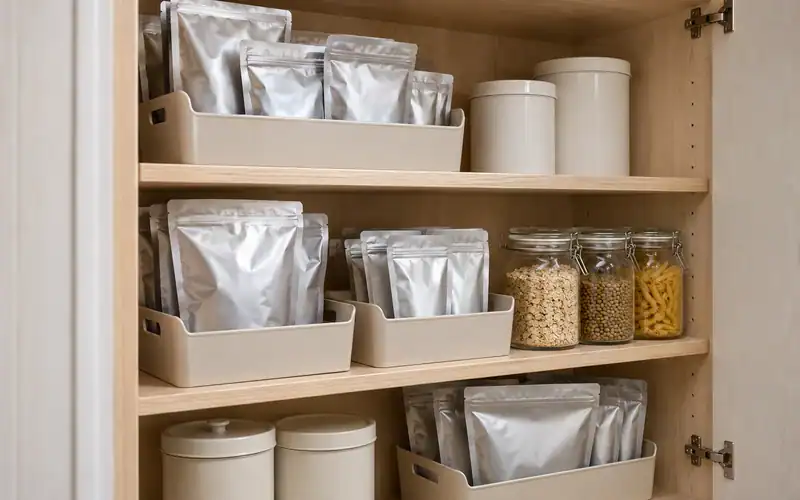
Sealed bags should then be placed in food-grade containers to deter rodents and pests, which can reach the film directly on open shelving. Seal integrity and secondary containment work together: a strong seam protects against air, while the outer container protects the seam from damage.

How to Store Freeze-Dried Food Step by Step?

Correct storage follows a fixed order: confirm the food is completely dry, fill the package while leaving headspace, add a correctly sized oxygen absorber, seal immediately, and verify the seal after one to two days. Skipping any step introduces spoilage risk.

Each step has a check that confirms it was done correctly, from a snap test on the dried pieces to a firmness check on the sealed bag.

Verify Food Is Fully Dry

Fully dried pieces snap cleanly and feel crisp when broken. Pieces that feel spongy or cool to the touch still retain moisture in the center.

Residual moisture causes spoilage even inside a well-sealed package, because the trapped water redistributes through the product over time. Verifying dryness before sealing is the highest-risk step to skip, since no packaging can correct moisture that was sealed in with the food.

Denser items such as freeze dried pumpkin dices deserve a check on a piece taken from the center of the batch.

Fill and Add Oxygen Absorbers

Headspace should be left at the top of the bag so the sealing area stays clear of product. The oxygen absorber is added last, immediately before sealing.

Absorbers lose capacity to ambient air once opened, so unused packets should stay closed until the moment they’re needed. Working quickly through filling and sealing preserves the absorber’s usable capacity for the sealed package instead of spending it on room air.

Seal and Verify the Package

Seals should be made in one smooth pass along the full width of the bag opening. The finished seam needs a check for wrinkles or trapped food particles, both of which create channels for air.

After 24 to 48 hours, a correctly sealed bag feels firm and compressed, because the absorber has removed the internal oxygen and the film has drawn in around the contents. A bag that remains puffy or loose indicates seal failure.

Visual and tactile verification identifies failed seals early enough to repack the product with a fresh absorber, before quality is affected.

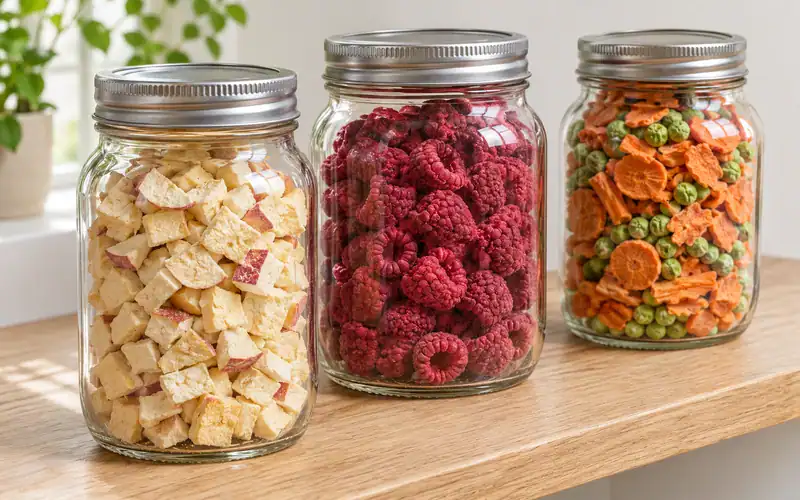
Airtight glass jars filled with dried food

Where Should Freeze-Dried Food Be Stored for the Longest Shelf Life?

Freeze-dried food keeps best in a cool, dry, dark location with stable temperature and low humidity. Storage areas exposed to heat, sunlight, damp conditions, or pests reduce shelf life even when the packaging itself is correctly sealed and intact.

Location choice covers what packaging cannot: steady temperature, low ambient humidity, darkness, and physical separation from pests.

Temperature and Humidity Conditions

Cool storage below normal room temperature extends shelf life, since heat accelerates the chemical degradation behind flavor, color, and nutrient loss. Humid environments place continuous pressure on the packaging barrier, because the moisture gradient across the film never eases.

Stable conditions do more for shelf life than the absence of any single short temperature spike. A consistently cool room outperforms a space that swings between cool and warm across seasons.

Light and Pest Protection

Light degrades vitamins and causes flavor loss, so dark storage supports the barrier the packaging provides. Opaque packaging outperforms window-panel bags for this reason, since a clear panel admits light directly onto the product.

Rodents and insects can chew through mylar film, which makes location and containment part of the protection plan. Storage location compensates for the physical limits of the packaging itself, keeping sealed bags away from sunlight and pest access points.

Bulk and Warehouse Storage Considerations

Stacked bulk storage introduces puncture risk, as the weight of upper units presses bags against pallet edges, corners, and each other. Distribution and warehousing also involve temperature fluctuation across transit legs and holding facilities.

Commercial-scale storage therefore requires stronger physical and thermal protection than small household batches. FNH provides private label and custom packaging design, and its private label packaging service supports buyers matching package construction to their handling and distribution conditions.

What Are the Pros and Cons of Mylar Bag Storage?

Mylar bag storage provides strong protection against oxygen, moisture, and light, which supports long shelf life when paired with oxygen absorbers. Drawbacks include reduced reliability in freezing conditions, vulnerability to punctures and pests, and the equipment cost required for proper sealing.

The balance between barrier performance, physical durability, and consumable cost decides whether mylar suits a given storage program.

Main Advantages

Mylar provides a triple barrier against oxygen, moisture, and light in a single film. Pairing that film with oxygen absorbers extends shelf life substantially, because the absorber clears the oxygen the seal traps inside.

Ordinary sealed bags perform far worse over long periods, since their film admits air gradually. Barrier performance converts directly into storage stability, which is why mylar remains the reference material for long-term dry storage of products such as freeze dried vegetables.

Practical Limitations

Mylar performs poorly in freezing conditions, where the film becomes less reliable. Pests can chew through the film, so unprotected bags on open shelving remain at risk.

Window-panel designs reduce light protection by exposing part of the contents. These limits require compensation through storage location and secondary containers, which handle the physical and thermal risks the film can’t manage on its own.

Cost and Maintenance Impact

Absorbers and heat-sealing equipment add upfront cost to a mylar storage program. Seals also require verification within 24 to 48 hours, which adds a labor step to each packing run.

Different package sizes carry different consumable costs, since absorber capacity and film area both scale with volume. Upfront equipment investment plus these verification steps determine the real long-term cost efficiency of the method.

Mylar Bags vs Vacuum-Sealed Bags: Which Is Better for Freeze-Dried Food?

Mylar bags outperform vacuum-sealed bags for long-term freeze-dried food storage because their metalized layer blocks light and oxygen far more effectively. Vacuum-sealed bags remove air well but use clearer, more permeable film, making them better suited to shorter-term freezer storage.

The two methods differ in film material and in how each removes oxygen. Those two factors set the storage window for each.

Introducing Mylar and Vacuum-Sealed Bags

Mylar bags use metalized barrier film and rely on oxygen absorbers to clear the air sealed inside the package. Vacuum-sealed bags use clearer plastic film and remove air mechanically by vacuum before the seal closes.

Material and oxygen-removal mechanism together define each method’s core use case, with the metalized film supporting extended shelf storage and the vacuum method supporting shorter cycles.

Comparing Key Differences

Mylar is opaque, while vacuum-sealed film is typically transparent, so light reaches the product in the vacuum-sealed format. Vacuum-sealed film also allows gradual oxygen migration over time, meaning the low-oxygen condition created at sealing doesn’t hold indefinitely.

Mylar requires an oxygen absorber to reach a low-oxygen state, while vacuum sealing does not. These barrier differences determine which method fits long-term storage and which works better for shorter-term storage.

CriterionMylar bagsVacuum-sealed bags
Film typeMetalized polyesterClearer plastic
Light barrierOpaqueTransparent
Oxygen removalOxygen absorberMechanical vacuum
Oxygen migration over timeBlocked by metalized layerGradual
Freezing conditionsUnderperformsSuitable
Best storage windowLong-termShort-term

Choosing Between Mylar and Vacuum Sealing

Mylar with oxygen absorbers suits room-temperature, long-term storage of freeze-dried food, including bulk stock and freeze dried fast food meal formats. Vacuum-sealed bags suit freezer storage of higher-moisture foods, where mechanically removing the air is sufficient for a shorter holding period.

Mylar underperforms in freezing conditions, so buyers storing at sub-zero temperatures should select the vacuum format. Intended storage duration and environment determine the correct packaging choice.

Organized cool dry pantry shelves

Frequently Asked Questions

How long does freeze-dried food last after opening?

Opened freeze-dried food begins reabsorbing moisture from the air immediately, so its usable life drops from years to a much shorter window. Resealing the package tightly and keeping it in cool, dry conditions slows the loss of crispness and flavor.

Can freeze-dried food be stored in the freezer?

Freeze-dried food doesn’t require freezer storage, since it’s shelf stable at cool room temperature. Mylar packaging underperforms in freezing conditions, so vacuum-sealed film is the better format when freezer storage is chosen.

How can spoiled freeze-dried food be identified?

Signs include moisture inside the package, mold, off odors, and a soft texture in a product that should snap crisply. Damaged packaging, or a bag that stayed puffy after sealing, also indicates the barrier failed and the contents should be discarded.

Do freeze-dried meals require refrigeration?

Sealed freeze-dried meals don’t require refrigeration, because removing moisture prevents microbial growth at room temperature. A cool, dry, dark storage area is sufficient until the package is opened and rehydrated.

What packaging standards should brands check when buying freeze-dried food in bulk?

Buyers should confirm barrier film construction, seal integrity, absorber sizing relative to package volume, and the supplier’s food-safety certifications. FNH holds ISO 22000, HACCP, FDA, BRC, HALAL, and KOSHER certifications and applies 20 testing stages to maintain stable product quality.

Conclusion

Storing freeze-dried food well comes down to controlling four variables: oxygen, moisture, light, and temperature. Metalized mylar packaging paired with correctly sized oxygen absorbers addresses the first three, while a cool, dry, dark storage location handles the fourth.

Vacuum sealing serves a different purpose and suits shorter-term freezer storage rather than long-term shelf storage. The process matters as much as the material, since residual moisture, a weak seal, or an undersized absorber can undermine otherwise suitable packaging.

For food brands and distributors, packaging quality and supplier certification standards carry the same weight as the product itself. Further details on freeze-dried products and packaging support are available from FNH.

How Long Does Freeze-Dried Food Last? Shelf Life Guide

Freeze-dried food is famous for its long shelf life, but if you look around online, you’ll find wildly different numbers. Some say 10 years, others claim 30. Honestly, it mostly depends on the food type, the packaging, and how you store it.

Most freeze-dried foods, when packaged right, last between 10 and 25 years. Low-fat items like fruits, vegetables, and plain grains tend to last the longest. Meats, dairy, and mixed meals usually sit at the shorter end because of their fat content. Once you open a package, though, forget about decades—it’s best to use it within days or weeks.

The reason shelf life varies so much isn’t really about freeze-drying itself. It’s about what’s left behind—fat, sugar, and any moisture can all speed up spoilage. The next sections break down shelf life by food type, explain what actually causes freeze-dried food to go downhill, and touch on why published numbers are all over the place.

What Determines How Long Freeze-Dried Food Lasts?

Shelf life comes down to how much water is left, how the food changes over time, and how well the packaging keeps out moisture and air. Several things work together, but some matter more than others.

Residual Moisture and Water Activity

Freeze-drying pulls out about 98 to 99 percent of the water. That tiny bit left is called residual moisture. But here’s the thing—residual moisture and water activity aren’t quite the same.

Moisture content tells you how much water is there in total. Water activity measures how much of that water is actually available for bacteria, molds, or chemical reactions.

Freeze-drying drops water activity below what micro-organisms need to grow. So, just having a low moisture percentage doesn’t guarantee a long shelf life. It’s really water activity that matters most.

Microbial Control Versus Chemical Change

Low water activity keeps bacteria and mold at bay, so microbes aren’t usually what ends the shelf life. But chemical changes keep going.

Fats react with oxygen (that’s lipid oxidation), color changes happen, and vitamins slowly break down with time and light. These things don’t need microbes.

In practice, shelf life ends when flavor, color, or nutrition drop off too much, not when the food becomes unsafe.

Mylar food storage bags with oxygen absorbers

Five Factors Ranked by Impact

Here’s how the main factors stack up, from most to least important:

RankFactorWhy it matters
1Residual moisture and water activitySets the baseline stability of the dried product
2Packaging barrier performanceControls how much moisture and oxygen reach the food
3Storage temperatureHigher temperatures speed up chemical reactions
4Residual oxygen inside the packDrives oxidation of fats and pigments
5Raw material fat contentFat-rich foods oxidize sooner than lean ones

All five need to be right for a long shelf life. If even one is off, shelf life can drop dramatically—sometimes by a factor of ten.

So, it makes sense to prioritize the top ones first. Getting the drying right and using a solid barrier package matter more than fussing over oxygen in a bag that already leaks moisture.

How Long Does Freeze-Dried Food Last by Food Type?

Shelf life varies by product. Low-fat, single-ingredient foods last the longest. Mixed recipes are limited by their weakest ingredient, and once you open any pack, it starts pulling in moisture from the air.

Fruits and Vegetables

Freeze-dried fruits and veggies are low in fat, so they last the longest. The way they’re cut matters too—dices, slices, whole pieces, granules, and powders all dry differently. Powders have more surface area, so they’re extra sensitive to packaging quality. According to manufacturers, their freeze-dried products can stay fresh and nutritious for up to 20 years if stored right. It’s really the combo of thorough drying and low fat that lets these foods outlast meat, dairy, and eggs.

Soups and Mixed Formulations

Mixed products combine several ingredients, each with its own stability. Freeze-dried soups, blends, and full meals are good examples. The least stable ingredient—usually something fatty or dairy—sets the overall shelf life, not the dried veggies or starches. That’s why shelf life numbers for mixed products are all over the place. If you want a specific shelf life, you really need to plan for it when designing the recipe.

Shelf Life After Opening

Freeze-dried foods are porous, and they soak up moisture fast once opened. After opening, you’re looking at days or maybe a few weeks, not years. Humid air shortens that even more. If you leave a pack unsealed, it’ll lose crispness quickly. Splitting your stash into smaller packs helps, since you’re not exposing everything to air each time.

Why Do Published Freeze-Dried Shelf Life Figures Disagree?

It’s easy to get confused when different sources list wildly different shelf lives for the same product. Usually, it’s because of missing details—two big reasons stand out: unclear test conditions and different definitions of what “shelf life” even means.

Unstated Testing Assumptions

Most published shelf lives don’t explain the packaging used, the storage temperature, if oxygen was removed, or whether the item was a single ingredient or a mixed product. A 25-year shelf life in a sealed, oxygen-controlled can isn’t the same as something tossed in a regular plastic bag in a warm warehouse.

The actual number isn’t as useful as knowing the conditions behind it. A smaller figure with clear conditions is more trustworthy than a bigger one with no details. It pays to check the fine print.

Safety Life Versus Best Quality Life

Shelf life can mean two things: how long the food stays safe to eat, or how long it keeps its best flavor, color, and texture. The “best quality” period is usually shorter and more conservative. That’s why the pack date is more about quality than safety.

Depending on which definition a source uses, you might see shelf life claims that are double or triple each other. Something labeled as safe for 30 years might only taste its best for a much shorter time.

Labeled food packages with expiration dates

What Are the Pros and Cons of Long Freeze-Dried Shelf Life?

Long shelf life is a big plus for freeze-dried food—great for storage, shipping, and steady supply. But there are limits, since shelf life depends on packaging and temperature, and both add cost.

Main Advantages

Freeze-dried food stores at room temperature, so you don’t need a cold chain. It’s light and compact, making shipping cheaper per serving. You can get supply year-round, no matter the season, and there’s less spoilage. All this comes from very low moisture and low water activity, making it handy for pre-made meals, snacks, and as ingredients.

Practical Limitations

Shelf life only holds if the packaging stays intact. High-barrier film and good seals are a must. Warmer storage cuts shelf life fast, so cooler warehouses are best. Foods high in fat or sugar don’t last as long, so they’re often left out of recipes meant for long-term storage. Usually, flavor and color fade before the food becomes unsafe, so “best quality” dates are set with that in mind.

Packaging and Storage Cost Impact

High-barrier packaging that blocks oxygen and moisture costs more than regular plastic bags. Temperature-controlled storage and shipping add even more. Still, lower spoilage and less waste can balance out those extra costs over time.

How Does Freeze-Dried Shelf Life Compare With Dehydrated, Canned and Frozen Food?

Freeze-drying, dehydration, canning, and freezing all slow spoilage, but they do it differently and last for different periods. Storage needs, packaging, and texture also set them apart.

Introducing the Preservation Methods

Freeze-drying starts by freezing the food, then removes ice as vapor under low pressure. The result? A porous, super-dry product.

Dehydration uses warm air to evaporate water. It’s cheaper and simpler but shrinks the food and leaves more water behind.

Canning heats sealed food to kill micro-organisms. The food stays wet, so texture and some vitamins take a hit.

Freezing keeps water in the food as ice, stopping microbes but requiring a constant cold chain from start to finish.

Comparing Key Differences

Here’s how they stack up for storage, conditions, and weight:

MethodTypical storage periodStorage conditionsWeight and volume
Freeze-driedLongest of the four, in high-barrier packaging with oxygen controlAmbientGreatly reduced
DehydratedShorter than freeze-dried under the same packagingAmbientReduced
CannedLong, but limited by can seal and contentsAmbientFull weight retained
FrozenMonths, not yearsFrozen cold chainFull weight retained

Freeze-dried foods last the longest because their water activity—the free water microbes need—is extremely low. Dehydrated foods keep more water, so their shelf life is shorter.

Canned and frozen foods keep all their water, which means more weight to ship, and frozen foods demand a cold chain all the way to the end user.

Choosing the Right Preservation Format

The best preservation format really depends on how you plan to use the food—not just on how long it’ll last.

Freeze-drying works well for low-fat fruits, veggies, and ingredients where you want room temperature storage and a long shelf life. Because freeze-dried foods are so porous, they rehydrate fast—pretty handy if you’re in a hurry.

Dehydration is fine for foods where a chewy texture isn’t a dealbreaker and you’re watching costs.

Canning is great for wet, ready-to-eat items. Freezing is your friend if you want to keep that just-picked texture and already have cold storage available.

High-fat or high-sugar foods don’t freeze-dry well. For those, you’ll need a different method.

Freeze-dried foods stored in airtight jars

How Does Storage Affect Freeze-Dried Food Shelf Life?

Storage conditions make or break shelf life. If you don’t control them, even a sealed pack can go bad years before it should. Temperature, humidity, oxygen, and light all attack at once, and you’ll notice real changes if you lose control of any one of them.

Temperature and Humidity Thresholds

Cool, dry storage stretches out shelf life. Warm, damp storage cuts it short. Most in the industry shoot for a stable temp around 20 °C or lower—any extra heat just speeds up browning and oxidation in the package.

ConditionTarget rangeEffect when exceeded
Storage temperatureAround 10–20 °C, stableFaster flavour and colour loss
Ambient humidityBelow about 60% RHMoisture pressure on seals and opened packs
Light exposureDark storageSlow vitamin and pigment loss

Temperature swings can be just as bad as high heat. When temps go up and down, air gets pulled through weak seals.

Storage Failure Mechanisms

Most storage problems start with the packaging, not the food itself. A tiny hole, a weak heat seal, or a punctured mylar layer lets in moisture and oxygen, and the food inside soaks it up fast.

Old or missing oxygen absorbers leave oxygen in the pack, which speeds up fat oxidation if there’s any fat in the food.

Other common mistakes:

Using airtight containers as a backup helps, but they can’t fix a pouch that’s already compromised.

Signs of Spoiled Product

Usually, you’ll spot signs of failure before the food gets unsafe. If you see clumping, soft or leathery pieces, or a pack that’s gone floppy, it’s probably picked up moisture.

Keep an eye out for:

If you see mold or smell rancid odors, don’t taste it—just toss it. And if you find a bad pack, check the rest stored nearby, just in case.

How to Verify a Supplier’s Freeze-Dried Shelf Life Claim?

Shelf life numbers only mean something if you know the conditions behind them. If you’re buying, check three things: storage assumptions, the packaging specs, and the testing or process records that back up the claim.

Confirm the Stated Storage Conditions

When a supplier claims 20 or 25 years, that’s based on a certain storage setup—not just any old warehouse. Always ask for the assumed temperature, humidity, and light exposure for the claimed shelf life.

Consistent, cool storage matters more than just hitting a low temp once. Keeping things around 15 to 20 °C is much better than bouncing between hot days and cool nights.

Brands like Mountain House, Augason Farms, and Peak Refuel put their shelf life claims right next to storage advice. The same goes for wholesale supply. If a supplier won’t name the storage conditions, you really can’t compare their shelf life to anyone else’s.

Check Packaging Specification Match

The claimed shelf life needs to match the actual packaging you’re getting. A #10 can with a sealed lid and a mylar pouch with an oxygen absorber will protect food much better than a plain vacuum bag or a glass jar with a plastic lid.

Ask for the packaging specs in writing. Key details to request:

Item to requestWhy it matters
Film structure and thickness of the mylar bagControls oxygen and moisture barrier
Oxygen transmission rate (OTR)Lower numbers slow oxidation of fats and pigments
Moisture vapour transmission rate (MVTR)Shows how fast food will soak up water
Oxygen absorber size and residual oxygen levelConfirms the pack is nearly airtight
Seal width and seal strength test resultA weak seal can ruin even the best film

If the claim is for #10 cans, don’t assume it applies to buckets, vacuum bags, or retail pouches. The spec should spell out the exact format you’ll get.

Verify Process Control and Testing

Documentation shows if the shelf life claim is based on real data or just marketing fluff. Suppliers can provide product specs, water activity and moisture results, micro tests, and a written shelf life statement.

Water activity tells you how much free water is left for microbes. Residual moisture is what’s left after drying. Both should be on the certificate of analysis, along with the test method used.

Ask how they estimated the shelf life. Real-time storage trials, accelerated testing at higher temps, or regular checks for flavor, color, and texture all give different confidence levels. The method should be listed with the result.

Frequently Asked Questions

How long does freeze-dried food last after opening?

Once you open it, freeze-dried food is best used within a few weeks. The porous texture means it sucks up moisture fast. Resealable bags or airtight jars help, but close them right away every time.

How long does homemade freeze-dried food last in storage?

Home batches can last years if they’re fully dry and sealed in barrier packaging with oxygen absorbers. The big risk is not drying thoroughly—any dampness inside shortens shelf life.

How long does freeze-dried meat last?

Freeze-dried meat usually doesn’t last as long as fruits or veggies. Fats keep oxidizing even after drying. Using lean cuts, keeping oxygen low, and storing cool will give you the best results.

How long does freeze-dried fruit last after opening?

Opened freeze-dried fruit softens up fast in humid air, since sugars grab moisture. Breaking it into smaller resealable bags helps keep the main stash fresher longer.

How long does freeze-dried food last without oxygen absorbers?

Without oxygen control, you’re looking at months to a few years, not decades. Oxygen causes fat oxidation and color loss. Good barrier packaging helps, but it can’t remove oxygen already inside.

Does freeze-dried food go bad over time?

Freeze-dried food usually loses quality—flavor, color, vitamins—before it’s unsafe. Heat, light, air, or moisture all speed up that decline and cut the shelf life.

Conclusion

Freeze-dried food can last for years, but honestly, it all comes down to the conditions. You need low residual moisture and low water activity as your foundation. Then, things like barrier packaging, cool storage, and keeping out oxygen help protect that foundation over time.

Shelf life shifts depending on what you’re storing:

If you’re trying to make sense of shelf life numbers, two habits help a lot. First, always check the assumptions: What kind of packaging? What temperature? How’s the oxygen managed? Without that, numbers don’t mean much. Second, see if the number is about safety or just best quality—they’re not the same, and the difference can be huge.

Once you open a pack, everything changes. The porous structure just soaks up moisture from the air, so you’ve got days or maybe weeks, not years. Resealing and splitting portions helps, but if it’s humid, you’ll lose shelf life fast.

For B2B planning, the steps are pretty straightforward:

PriorityAction
1Keep residual moisture and water activity low
2Use high-barrier packaging
3Store at cool temperatures
4Minimize oxygen inside the pack
5Check fat content in raw materials early on

The top priorities matter most. Shelf life targets only work when you nail all these factors at the same time. Miss one, and the whole thing can fall apart.

Is Freeze-Dried Food Healthy? Nutrition and Benefits Explained Guide

Freeze-dried food is generally a healthy choice since the low-temperature vacuum process preserves most of the protein, minerals, fiber, and many vitamins from the original ingredients. Water gets pulled out by sublimation, which is just a fancy way of saying ice skips the liquid stage and turns straight into vapor. This gentle approach skips the high heat used in lots of other preservation methods.

Nutrition does vary by nutrient. Protein, minerals, and dietary fiber hold up well. Vitamin C and some antioxidants are more sensitive—they react to heat and oxygen, even after processing.

This article dives into how freeze-drying works, which nutrients make it through, where freeze-dried foods fall short, and how they stack up against dehydration, canning, freezing, and fresh produce.

What Is Freeze-Dried Food and How Does the Freeze-Drying Process Work?

Freeze-dried food has had its water removed at low temperature under vacuum, so the ice turns straight into vapor. The final product depends on how the water is removed, how the drying stages are managed, and how quickly the food was frozen at the start.

Sublimation and Water Removal

Freeze-drying (or lyophilization, if you want to sound fancy) removes moisture through sublimation. That just means ice changes directly into vapor, skipping the liquid phase.

Food contains two types of moisture. Free water freezes and comes out first; bound water is locked inside the food and doesn’t freeze the same way.

Pulling this water out drops the food’s water activity—the amount of moisture available for microbes to use.

Lower water activity keeps bacteria, yeasts, and molds at bay. So, taking out water slows down the microorganisms that spoil food.

Three Drying Stages

The freeze drying process runs in three stages: freezing, primary drying, and secondary drying. Primary drying removes the frozen free water by sublimation.

Secondary drying (or desorption drying) takes out the bound water left in the food’s structure. Both stages use low temperature and vacuum, which protects heat-sensitive nutrients.

How well secondary drying is finished determines how much moisture is left in the product. That leftover moisture sets the upper limit for shelf life.

If you leave more moisture, the shelf life drops—even if everything else is perfect.

Freezing Rate and Ice Crystals

Freezing is probably the most critical step because it locks in the food’s internal structure before any water is removed.

Fast freezing creates tiny ice crystals. Slow freezing makes big crystals that can wreck cell walls from the inside.

It’s a chain reaction:

Slow-frozen products often rehydrate into softer pieces that leak more liquid. Rapid freezing helps food hold its shape better.

This is why two products labeled freeze-dried aren’t always equal. The label tells you the preservation method, not the freezing conditions behind it.

Fresh fruit beside dried fruit snacks

Does Freeze-Drying Destroy Nutrients in Food?

Freeze-drying preserves most nutrients because it removes water at low temperature under vacuum, skipping the high heat that can break them down. Still, retention varies depending on the nutrient, drying time, and how tests are set up.

Nutrient Retention by Type

Protein and minerals stick around best—they aren’t damaged by low-temperature processing. B vitamins and fat-soluble vitamins A and E also survive well. Dietary fiber stays pretty much untouched, since its structure doesn’t depend on heat. Polyphenols and other antioxidants do better than in hot-air drying, but results depend on the specific food. The main reason? The process stays cold, so nutrients that usually break down under heat are mostly preserved.

Heat-Sensitive Nutrient Losses

Vitamin C is the big exception—it’s sensitive to both heat and oxygen. If secondary drying drags on, the product spends more time exposed to oxygen. The porous structure from sublimation also increases the surface area for oxygen to react with. So, drying time and surface area both affect how much vitamin C you lose. Even so, freeze-drying still beats hot-air drying, where high temperatures really take a toll.

Testing Conditions Behind Retention Figures

Published retention numbers often skip important details, making them tough to compare. Three questions matter:

Without those details, a retention number only describes one specific test—not all freeze-dried food.

What Are the Pros and Cons of Freeze-Dried Food?

Freeze-dried food keeps nutrients well, stores easily, and weighs less, but it also packs more calories by weight, has some food safety quirks, and costs more to make. Here’s a quick look at the main upsides, practical drawbacks, and how cost and packaging come into play.

Main Advantages

Most benefits of freeze-dried food come from one thing: low-temperature vacuum sublimation, where ice turns straight into vapor without melting.

Because heat stays low, nutrition, flavor, and color remain close to fresh. Removing water drops water activity enough for room-temperature storage, so you don’t need preservatives.

Taking out water makes food lighter and smaller, so it’s easier to ship and store. The porous structure left behind means it rehydrates quickly when you add liquid.

These perks fit some uses perfectly:

Practical Limitations

Freeze-drying isn’t perfect, and each limitation has a practical fix.

Taking out water concentrates calories by weight, so a small serving packs more energy than fresh produce. Watching portion sizes by weight helps keep things predictable.

The crisp texture and strong flavor make these foods easy to eat fast, which can lead to bigger portions. Single-serve packs can help curb that.

Freeze-drying doesn’t kill pathogens. Raw meat and eggs survive the process, so you need to cook them before eating, and labels have to make that clear.

Allergens aren’t removed either. Any allergy-causing ingredients stick around and must be listed on the label.

Snack bowl with dried berries

Cost and Storage Impact

Freeze-drying uses vacuum equipment and long drying cycles, so energy and equipment costs push the price higher than hot-air drying.

That upfront cost often pays off with a longer shelf life and less spoilage during storage and shipping.

Packaging is critical. Barrier packaging that blocks moisture and oxygen is a must for the promised shelf life. If the packaging doesn’t match, shelf life drops—no matter how good the drying was.

Not every food is a good fit, either. High-fat and high-sugar foods don’t freeze-dry well, since fat doesn’t sublimate and sugar resists drying.

Is Freeze-Dried Food Healthier Than Dehydrated, Canned, Frozen or Fresh Food?

Each preservation method handles moisture differently, and that affects nutrient retention, shelf life, and texture. Here’s a look at how freeze-drying compares with dehydration, canning, freezing, and fresh food, focusing on process temperature, vitamin and antioxidant retention, additives, and rehydration.

Introducing Freeze-Dried and Alternative Methods

Freeze-drying pulls out moisture using low-temperature vacuum sublimation—ice goes straight to vapor. Dehydration uses hot air to evaporate water, so food sits in heat for hours.

Canning sterilizes food at high temperature in sealed containers, which kills microbes but also brings the most heat stress. Freezing keeps food cold and the water inside, just holding it as ice.

Fresh produce gets no preservation at all. Its moisture and structure stay untouched.

These five methods mainly differ in how they handle water and how much heat the food gets. That’s what really sets them apart.

Comparing Key Differences

DimensionFreeze-DriedDehydratedCannedFrozenFresh
Processing temperatureLow, under vacuumHigh (hot air)High (sterilization)LowNone
Moisture removal / water stateWater removed by sublimationWater removed by evaporationWater stays in containerWater kept as iceWater fully retained
Vitamin retentionHighModerateLowerHighHighest at harvest
Antioxidant retentionBetter than hot-air drying, variesReduced by heatReduced by heatWell retainedWell retained
Dietary fiberEssentially unaffectedEssentially unaffectedEssentially unaffectedEssentially unaffectedUnaffected
Need for additivesNot needed for shelf stabilityVariesVariesNot requiredNot applicable
Ambient shelf lifeLong, if packaged rightModerateLongNone; needs cold chainVery short
Texture and rehydrationPorous, rehydrates fastDenser, slower to rehydrateSoftened by heatClose to fresh after thawingOriginal texture

Two factors matter most: shelf life at room temperature (freeze-dried and canned foods win here), and how well heat-sensitive nutrients survive (low-temperature methods keep more than high-heat ones).

Choosing Between Freeze-Dried and Fresh

Fresh produce packs the most nutrients right at harvest, but those nutrients drop during storage and transport. Freeze-dried foods keep their nutrition, flavor, and color at room temperature—no preservatives needed. That’s a big plus for long supply chains, prepped meals, snacks, and fruit and veggie smoothies.

Freezing keeps quality close to fresh, but you need constant cold storage. Canning is cheaper and shelf-stable, though you lose more heat-sensitive vitamins.

The best choice? It really depends on your needs. If you don’t have a cold chain and need a long shelf life at room temp, freeze-dried is the way to go—as long as the packaging actually protects the food.

Does Freeze-Dried Food Stay Healthy During Long Storage?

Freeze-dried food can keep its nutrition for years, but only if you control moisture, oxygen, light, and temperature. If any of these slips, quality drops way before the “best by” date.

Shelf Life Condition Factors

That “up to 25 years” shelf life? It only applies if storage conditions are ideal—not every freeze-dried product will last that long.

Here’s what really matters:

Food composition plays a role too. Plain fruits, veggies, and grains last longest.

Foods with more fat or sugar don’t keep as well—fats go rancid, sugars pull in moisture.

Storage Failure Mechanisms

Freeze-dried foods are full of tiny holes left by ice, which makes them rehydrate quickly but also exposes a lot of surface to air.

Oxygen is the main culprit for loss. It breaks down vitamin C, polyphenols, and fats, leading to faded color, stale taste, or rancid notes in fatty products.

Moisture is next. If the seal breaks or you store it in a humid room, water sneaks back in, raising water activity until mold or bacteria can start growing again.

Physical issues count, too. Tiny holes, weak seals, used-up oxygen absorbers, or crushed food that packs tight—all of these can shorten shelf life, no matter what the package says.

Nutritionist examining packaged healthy foods

How to Choose Healthy Freeze-Dried Food Products?

Quality varies a lot in freeze-dried foods. Buyers should use a methodical approach. Nutritional goals, label details, and supplier quality controls all offer clues about what you’re really getting.

Define Nutritional Requirements

Start with your purpose. A hiking meal, a snack, and a smoothie base all need different nutrition. Set your targets—calories, protein, sodium, added sugar—before you compare. Freeze-dried foods are calorie-dense by weight, since removing water concentrates everything else. So, portion size matters more than package weight. If you’re looking for fruit or veggie servings, focus on fiber and micronutrients, not just calories.

Check Label and Ingredient List

The ingredient list tells you if it’s a single freeze-dried food or a blend. Short lists with just the raw ingredient mean less processing. Longer lists might add sugar, oils, salt, or flavorings that change the nutrition. Labels should also say if there’s raw meat or egg—freeze-drying doesn’t kill pathogens, so those need cooking. Allergen info is still important; freeze-drying won’t remove those proteins.

On the label, look for:

Verify Supplier Process and Testing

Process matters. Freezing rate makes a difference—fast freezing forms tiny crystals that protect cell walls, while slow freezing creates big crystals that break down texture and cause more liquid loss when you rehydrate.

Ask suppliers for data on residual moisture and water activity. If secondary drying is incomplete, leftover water cuts shelf life. Water activity measures the free water microbes can use.

It’s smart to request microbiological test results, allergen control procedures, and food safety certificates—these give you proof, not just promises.

Frequently Asked Questions

What is freeze-dried food and how is it made?

Freeze-dried food gets frozen, then dried in a vacuum so the ice skips the liquid stage and becomes vapor. There are three steps: freezing, primary drying, and secondary drying (which removes water still trapped inside the food).

Does freeze-drying preserve the nutrients in fruits and vegetables?

Protein, minerals, and fiber stick around the best. B vitamins and fat-soluble vitamins A and E also do pretty well, since there’s no high heat. Vitamin C is trickier—it reacts to heat and oxygen, and the porous structure exposes it to air.

What are the main health benefits of freeze-dried foods?

Low-temp vacuum drying keeps nutrition, flavor, and color, plus you get shelf-stable products without preservatives. The porous texture also means fast rehydration, which is handy for meals, snacks, and smoothie bases.

Are freeze-dried fruits and vegetables helpful for weight management?

Removing water means more calories by weight, so a small portion of freeze-dried fruit has more energy than the same weight of fresh. Watch your portions—the crisp texture and strong flavor make it easy to overeat.

What should you look for when choosing healthy freeze-dried food products?

Check the ingredient list for added sugar, oil, or coatings. Make sure any raw meat or egg has been cooked—freeze-drying doesn’t kill germs. Barrier packaging is essential for shelf life, so the packaging spec should match what’s claimed on the label.

Close-up of freeze-dried fruit pieces

Conclusion

Freeze-dried food stands up pretty well as a nutritious choice. Thanks to the low-temperature vacuum process, protein, minerals, dietary fiber, and most vitamins stick close to what you’d get in fresh food. Flavors and colors mostly hang in there, too.

Are there downsides? Sure. But they’re usually manageable.

Compared to hot-air drying, canning, or freezing, freeze-drying usually gives you the best mix of long shelf life and decent protection for heat-sensitive nutrients. Of course, that perk comes with a higher price tag, mostly because the equipment and energy costs aren’t cheap.

For a lot of buyers, though, the longer shelf life and less waste can make up for the extra cost in the long run.

But let’s be honest—product quality isn’t the same across the board. Things like how fast something is frozen, how completely it’s dried, and what packaging is used all impact the end result. Two products both labeled “freeze-dried” can perform pretty differently.

If you’re sizing up suppliers, it’s smart to dig into details about their process control and how much moisture is left in the product, rather than just trusting broad claims about nutrient retention. Numbers only really mean something when you know what food was tested, when, and how those figures were calculated.

Freeze-Dried vs Dehydrated Food: What Is the Difference?

Freeze-dried food and dehydrated food share one goal. Both remove water so the food stays usable for longer. Water is what lets bacteria, yeast, and mold grow. Remove enough of it, and the food becomes far more stable at room temperature.

The two methods are still not the same. Freeze-dried food is made with freezing, vacuum, and sublimation. Dehydrated food is made mainly with heat and moving air. That single difference in method changes the structure of the food, and structure changes almost everything else.

This article compares the two processes across method, texture, nutrition, rehydration, storage, cost, and end use. It is written for brands, buyers, and product developers who need to choose a spec, not for home drying projects.

Freeze-Dried vs Dehydrated Food: The Quick Answer

Freeze-dried food is lighter, more porous, and faster to rehydrate. Dehydrated food is denser, chewier, and cheaper to produce. The table below sets out the main differences at a glance.

Comparison pointFreeze-dried foodDehydrated food
Drying methodFreezing, vacuum, and sublimationWarm air, airflow, and evaporation
Heat exposureLow; the food stays frozen while ice turns to vaporHigher; the food is warmed for hours
Final textureLight, porous, and crispFirm, chewy, or leathery
AppearanceClose to the original shape and colorShrunken, and often darker
RehydrationFast, often 3 to 10 minutes in hot waterSlower; may need soaking or cooking
StorageVery low moisture; needs strong moisture and oxygen barriersLow moisture; still needs good barrier packaging
WeightVery light, since most water is goneLight, but usually heavier than freeze-dried
CostHigher, because of long cycles and vacuum equipmentLower, because equipment and cycles are simpler
Common usesInstant soups, snack pieces, and cereal inclusionsDried fruit, dried herbs, and cooking ingredients

Is Freeze-Dried Food the Same as Dehydrated Food?

No. Freeze-dried food is not the same as dehydrated food.

In strict technical terms, freeze drying is one type of dehydration. Every drying method removes water, so freeze drying sits inside that wider family. In everyday trade language, though, the two words describe two different processes and two different results. When a buyer asks for “dehydrated” carrot dice, that buyer normally means hot-air dried carrot dice. When the same buyer asks for “freeze-dried” carrot dice, the spec, the price, and the texture all change.

That is why the two terms should never be used as substitutes on a label, a spec sheet, or a purchase order.

Assorted dehydrated food in bowls

How Is Freeze-Dried Food Made?

Freeze drying removes water from frozen food under vacuum. The food never passes through a wet, warm stage.

Freezing and Vacuum Drying

The process starts by freezing the food solid. Fast freezing matters here. It creates small ice crystals, and small crystals cause less damage to cell walls. Slow freezing creates large crystals, which tear the structure and soften the final product.

The frozen food then moves into a sealed chamber. A vacuum pump lowers the pressure inside. Low pressure is the key condition, because it allows ice to leave the food as vapor instead of melting into liquid. A condenser inside the system collects that vapor and traps it as ice.

How Sublimation Removes Water

Sublimation is the change from a solid straight to a gas, with no liquid stage in between. In a freeze dryer, the ice inside the food turns directly into water vapor.

This matters for product quality. The food keeps its shape because it dries while it is still frozen and rigid. Water leaves behind tiny open channels, so a freeze-dried strawberry slice stays close to the size of the fresh slice. A second stage, called desorption drying, then removes the small amount of bound water that sublimation leaves behind. Manufacturers run these stages as part of a controlled production line, and FNH sets out its full nine-step freeze-drying process flow for buyers who want to see how each stage fits together.

How Is Dehydrated Food Made?

Dehydration removes water by warming the food and blowing air across it. The water leaves as steam from a liquid state.

Heat, Airflow, and Evaporation

Warm air passes over the surface of the food. That air carries heat in and carries moisture away. Air temperatures for fruits and vegetables often sit between 50°C and 70°C, and the cycle can run for several hours.

Industrial plants use several designs, such as tunnel dryers, belt dryers, and cabinet dryers. Sun drying is still used in some regions for products like tomatoes and chilies. The common factor is simple: heat plus airflow equals evaporation.

How Dehydration Changes the Food

Evaporation pulls water out of the cells while the food is soft. The structure collapses inward as this happens, so the pieces shrink. A dehydrated apple ring is much smaller and thinner than the fresh ring it came from.

That collapse gives dehydrated food its familiar character. The pieces are firmer, chewier, or crisper in a hard way. Sugars and acids sit in a smaller volume, so the flavor often tastes more concentrated.

What Is the Difference Between Freeze-Dried and Dehydrated Food?

The main difference is the state of the water when it leaves the food. Everything below flows from that point.

Drying Method and Heat Exposure

Freeze drying uses freezing, vacuum, and sublimation. Dehydration uses heat, airflow, and evaporation.

Heat exposure is the practical gap. In freeze drying, the food stays frozen through the main drying stage, and gentle heat is only applied to drive sublimation forward. In hot-air drying, the food sits in warm air for hours. Longer heat contact affects color, aroma, and heat-sensitive nutrients.

Moisture Removal and Product Structure

Freeze-dried products usually finish with a very low moisture content, often in the range of 1% to 4%. Hot-air dried products usually finish higher, and many sit between 5% and 20% depending on the item.

These figures are typical ranges, not fixed rules. The real number depends on the raw material, the piece size, the recipe, and the target spec. A dried fruit designed to stay soft will hold more water than a crisp snack piece by design.

The structural result is consistent, though. Freeze-dried pieces are porous and hold their original shape. Dehydrated pieces are dense and clearly smaller than the fresh input.

Close-up of dried fruit slices

Texture, Shape, Color, and Flavor

Freeze-dried food is light and crisp, and it breaks with a clean snap. It also keeps color well, since low temperatures slow browning reactions. Freeze-dried fruits, such as strawberries, mangoes, and kiwi, stay bright enough to be used as visible inclusions in cereal and confectionery.

Dehydrated food is denser and chewier. Color often shifts toward brown or amber during drying. Flavor can taste stronger because the same sugars and acids now sit in a smaller piece.

Results always depend on the food type and the process settings. Piece size, sugar content, fat content, and cycle parameters all shape the final outcome.

Nutrient Retention

Both methods change the nutrient profile of the food to some degree. Heat-sensitive nutrients, such as vitamin C, thiamin, and folate, are the most affected by drying temperature and drying time.

Because freeze drying keeps the food cold during the main drying stage, it is generally gentler on these nutrients. That does not mean every freeze-dried product retains the same percentage. Retention varies by crop, variety, harvest maturity, and processing detail.

Minerals and fiber are stable in both processes. Storage also matters after production, since oxygen, light, and warmth slowly reduce sensitive nutrients over shelf life.

Rehydration Time and Final Texture

Freeze-dried food rehydrates faster. The open pore structure lets water travel back into the piece quickly, and many freeze-dried vegetables return to a usable texture within 3 to 10 minutes in hot water.

Dehydrated food takes longer. The collapsed structure has to open up again, so pieces may need a longer soak or a period of simmering. Some dehydrated ingredients are designed for slow cooking, where that longer time is not a problem.

Not every product needs rehydration at all. Freeze-dried fruit snacks and dehydrated fruit pieces are both eaten dry in many applications.

Shelf Life and Storage Needs

Lower moisture supports longer storage in both cases. Freeze-dried food starts from a lower moisture level, so it has a strong stability advantage on paper.

Real shelf life is never a property of the drying method alone. It depends on the formula, the residual moisture, the fat content, the barrier strength of the packaging, and the oxygen, light, and temperature in storage. A freeze-dried product in a thin, permeable bag can fail long before a well-packed dehydrated product.

Freeze-dried food is also hygroscopic, which means it pulls in moisture from the air quickly. High-barrier packaging is not optional for these products. Shelf-life claims should always be tied to a defined pack format and defined storage conditions.

Weight, Space, and Transportation

Freeze-dried food is usually lighter. Fresh fruits and vegetables often contain 80% to 90% water by weight, and freeze drying removes nearly all of it while keeping the original volume.

That volume is the trade-off. Freeze-dried pieces keep their full size, so a carton holds less weight for the same space. Dehydrated pieces shrink, so they can pack more densely.

For air freight and outdoor products, low weight usually wins. For sea freight of bulk ingredients, packing density can matter just as much.

Processing Cost and Production Scale

Freeze drying costs more per kilogram. The process needs freezing capacity, vacuum systems, and condensers, and a single cycle often runs for 20 to 40 hours.

Hot-air drying uses simpler equipment and shorter cycles. That makes it a better fit for high-volume, price-sensitive products where texture change is acceptable.

Buyers should read this as a value decision, not a quality ranking. The right question is whether the end product needs the appearance, the fast rehydration, and the light weight that freeze drying delivers.

Freeze-Dried vs Dehydrated Food: Which Works Well with Each Method?

Both methods suit different raw materials. The choice usually follows the intended eating experience.

Fruits, Vegetables, and Herbs

Freeze drying suits products where shape, color, and crispness carry the value. Freeze-dried vegetables, such as corn, bok choy, and shallots, drop into instant soups and ready meals and come back quickly in hot water. Freeze-dried fruit works well as a crisp snack, a topping, and a visible inclusion in bakery and cereal.

Dehydration suits products where a chewy bite or a concentrated flavor is the point. Dried fruit for baking, dried herbs for seasoning blends, and dried vegetable pieces for slow-cooked dishes all fit this profile.

Meat, Seafood, Dairy, and Prepared Meals

Composition drives the result for these categories. Fat, sugar, salt, and density all change how a food dries and how stable it is afterward.

Fat is the main limit. High-fat items can turn rancid over time, because drying removes water but not oil. Prepared dishes add another layer, since soups, sauces, and mixed meals must survive drying and then rebuild into the right texture with the right amount of water.

For that reason, prepared products are developed recipe by recipe. FNH produces freeze-dried fruits, freeze-dried vegetables, and freeze-dried prepared foods such as instant soups, and each recipe is matched to a target rehydration result rather than a single fixed setting.

Industrial food dehydrator trays

Which Is Better: Freeze-Dried or Dehydrated Food?

Neither method is better overall. Each one is better for a defined set of product goals.

Choose Freeze-Dried Food When Quality and Fast Rehydration Matter

Freeze drying fits products that must look close to fresh, weigh very little, and rehydrate in minutes. It also fits products aimed at long storage in strong packaging.

Typical examples include camping meals, emergency food kits, and instant soup cups. Premium snacks and cereal inclusions also rely on freeze drying, because the color and the clean crunch are part of what the shopper is paying for.

Choose Dehydrated Food When Cost and Compact Storage Matter

Dehydration fits products with tighter cost targets. It also fits products where a chewy texture or a concentrated flavor is desirable rather than a problem.

Typical examples include dried fruit pieces, dried herbs, and vegetable ingredients for soup bases and seasoning mixes. Compact, shrunken pieces can also lower freight cost per serving.

The Best Choice Depends on the Product Goal

The decision should start from the finished product, not from the process. Category, sales channel, target retail price, required shelf life, and eating experience all feed into it.

A brand selling a premium snack in a clear pack has different needs from a brand selling a bulk soup ingredient. Some ranges even use both methods in one product, with freeze-dried inclusions for appearance and dehydrated pieces for cost control.

Freeze-Dried vs Dehydrated Food:What Should Brands and Bulk Buyers Check Before Ordering?

Buyers should confirm the specification, the packaging, and the sample results before placing a bulk order. These three checks prevent most disputes later.

Product Specifications and Quality Documents

A written spec should cover the ingredient list, the product format, the moisture target, and the microbiological limits. Allergen information and batch documents should be included as well.

Requirements differ by destination market, so the spec should match the rules of the country where the product will be sold. Buyers should also ask which documents travel with each shipment, such as certificates of analysis, batch records, and packing lists.

Packaging and Storage Conditions

Packaging decides whether the product survives its stated shelf life. Buyers should check the moisture barrier, the oxygen barrier, and the seal method of the proposed pack.

Storage guidance after opening deserves the same attention, especially for freeze-dried items that absorb moisture fast. Any shelf-life statement should be written against a specific pack format and specific storage conditions.

Samples, Product Format, and Custom Packaging

Sample testing should come before volume commitment. A rehydration test in the buyer’s own recipe gives the clearest answer on texture and timing.

Format should be confirmed in writing, since options include whole pieces, slices, dices, flakes, and powders. Commercial terms belong in the same conversation, including minimum order quantity, pack sizes, labeling needs, and any custom packaging work.

Shelf-stable food pouches on a pantry shelf

Frequently Asked Questions

Is Freeze-Dried Food Healthier Than Dehydrated Food?

Not automatically. Freeze drying is gentler on heat-sensitive nutrients, because the food stays cold through the main drying stage. The final nutrition still depends on the raw material, the recipe, added ingredients, and storage time.

Which Lasts Longer: Freeze-Dried or Dehydrated Food?

Freeze-dried food usually has the longer potential shelf life, because it finishes at a lower moisture level. That potential is only reached with strong barrier packaging and cool, dry storage. Poor packaging shortens shelf life for either type.

Can Freeze-Dried and Dehydrated Food Be Eaten Without Rehydration?

Yes, in many cases. Freeze-dried fruit snacks and dried fruit pieces are both designed to be eaten as they are. Products built around a cooked meal or a soup base still need water to reach the intended texture.

Why Is Freeze-Dried Food Usually More Expensive?

The process takes longer and uses more equipment. A freeze-drying cycle can run for a day or more, and it needs freezing capacity, vacuum systems, and condensers. Hot-air drying uses simpler machines and shorter cycles, so the unit cost is lower.

Conclusion

Freeze-dried and dehydrated foods are two different answers to the same problem. Freeze drying uses freezing, vacuum, and sublimation to give light, porous pieces that keep their shape and rehydrate fast. Dehydration uses heat and airflow to give denser, chewier pieces at a lower production cost.

The right method is the one that matches the product goal. Appearance, rehydration speed, weight, shelf life, and target price should all be settled before the process is chosen. Brands and bulk buyers can review the available freeze-dried food options by category, then request samples and discuss custom formats, packaging, and private label programs with the FNH team.

What Is Freeze-Dried Food? A Simple Guide to How It Works

Freeze-dried food is now common in snack aisles, drink mixes, bakery products, soups, and ready meals. Its low weight and crisp texture make it easy to recognize. Yet the name can cause confusion. Freeze-dried food is not simply frozen food, and it is not made by ordinary hot-air drying.

The process starts with frozen food. A vacuum then helps turn the ice inside the food into vapor. This removes most of the water while the product stays at a low temperature. The result is a dry, light food that can keep much of its original shape and can often take up water again with ease.

For food brands and buyers, the value of freeze-drying goes beyond shelf life. Product form, final moisture, water activity, packaging, and storage all affect the finished result. This guide explains each part in simple terms.

What Is Freeze-Dried Food?

Freeze-dried food is food that has been frozen and dried under low pressure. The method is also called lyophilization. During the main drying stage, ice leaves the food as vapor without first becoming liquid water. This change is called sublimation.

The process is different from placing food in a freezer. Frozen food still holds almost all of its water and normally needs a cold chain. Freeze-dried food has had most of that water removed. When the product reaches its target condition and receives suitable packaging, it may be stored without freezing. The label and the manufacturer’s storage directions still control how each product should be handled.

Industrial freeze dryer inside a food factory

How Does Freeze-Drying Food Work?

Freeze-drying works by freezing the water in food and then removing that ice in a vacuum. Commercial production uses controlled time, temperature, and pressure. The exact settings depend on the recipe, piece size, sugar level, fat level, and final product goal.

Step 1: Preparing the Food

The first step prepares clean, suitable raw materials for even processing. A manufacturer may sort, wash, peel, trim, or cut fruits and vegetables. Meals may require weighing, mixing, cooking, cooling, and portioning. Some vegetables may be blanched. Other foods need different controls. The preparation method must match the food and its intended use.

Step 2: Freezing the Food

The prepared food is frozen until the water inside it forms ice. Complete and controlled freezing is important. Ice crystal size can affect the small open spaces left in the food after drying. Those spaces influence texture and rehydration. The best freezing profile is therefore set for the product rather than copied from a different food.

Step 3: Removing Ice in a Vacuum

The frozen food enters a chamber where pressure is lowered. The equipment adds carefully controlled heat. Under these conditions, the ice can change directly into water vapor. A cold surface inside the system collects that vapor as ice. This stage removes most of the frozen water and is often called primary drying or sublimation drying.

Step 4: Removing the Remaining Moisture

After the visible ice is gone, a small amount of water can still be attached to the food’s solids. A secondary drying stage removes more of this bound moisture. This stage is also called desorption drying. The process ends only after the product reaches its approved final target. Manufacturers may check moisture, water activity, weight, texture, or other product specifications.

Step 5: Packaging the Freeze-Dried Food

Finished freeze-dried food can absorb moisture from the air very quickly. Packaging should therefore follow without an unnecessary delay. The chosen pack must fit the product and its planned shelf life. Moisture barrier, oxygen barrier, seal quality, light protection, headspace, and pack size can all matter. Packaging does not correct an incomplete drying process, but it protects a properly finished product from the outside environment.

Why Does Removing Water Help Preserve Food?

Removing available water slows many causes of food spoilage. Bacteria, yeasts, and molds need available water to grow. Enzymes and chemical reactions can also change flavor, color, and texture over time. A dry product gives these processes less water to use.

Total moisture and water activity are related, but they are not the same measure. Moisture content shows how much water is present. Water activity shows how available that water is for microbial growth and chemical change. Commercial shelf-life decisions should use product testing and a suitable packaging study, not appearance alone.

Low water activity can stop microbial growth while the pack stays dry and sealed. It does not prove that all microbes were killed. If a contaminated product takes up water again, surviving microbes may become active. This is why raw material control, hygiene, validated processing, testing, and package integrity remain important.

Frozen food pieces arranged on metal trays

What Is Freeze-Dried Food Like?

Light and Crisp

Freeze-dried food is light because most of its water is gone. Many fruits and some vegetables become crisp enough to eat as snacks. The exact bite depends on the food’s natural structure, sugar, starch, fat, cut size, and final drying target.

Similar in Shape and Color

Low-temperature water removal can help a food keep more of its original shape and color than some high-heat drying methods. However, the result is not identical to fresh food. Raw material quality, browning, pretreatment, freezing, drying, oxygen, and light can all change the final look.

Easy to Rehydrate

Sublimation leaves small pores where ice once sat. Water can move into these open spaces during rehydration. Powders and small pieces often take up water faster than large pieces. Some products return close to a soft, fresh-like texture, while others are best used in soups, sauces, or blended formulas.

Concentrated Flavor

Removing water can make flavor seem stronger when the food is eaten dry. Sweetness, acidity, aroma, and seasoning may feel more concentrated in a crisp piece. Once water is added, the flavor balance changes again. Product developers should test the food in the form in which the customer will use it.

Freeze-Dried Food vs. Frozen and Dehydrated Food

Freeze-dried, frozen, and dehydrated foods use different ways to manage water and quality. The best choice depends on the product, sales channel, budget, storage plan, and expected eating experience.

FeatureFreeze-Dried FoodFrozen FoodDehydrated Food
Main methodFreezing, vacuum, and sublimationCold storage keeps water frozenHeat and moving air often evaporate water
Water in productMost water is removedMost water remainsA large share of water is removed
StorageOften shelf-stable in a suitable sealed packNeeds continuous frozen storageOften shelf-stable in a suitable sealed pack
Typical textureLight, porous, and often crispFirm while frozen; softer after thawingChewy, leathery, crisp, or firm
RehydrationOften fast because of open poresNot required; product is thawedOften slower and may be less complete
Production costUsually higher due to equipment and cycle timeCold-chain cost continues through storage and shippingUsually lower than freeze-drying

What Foods Can Be Freeze-Dried?

Many fruits, vegetables, cooked meals, and food ingredients can be freeze-dried. A food’s composition affects how well it dries. Foods that contain much fat or sugar can be more difficult to process and may need special product development.

Freeze-Dried Fruits

Common choices include strawberries, bananas, apples, blueberries, peaches, pineapple, and dragon fruit. They may be supplied whole, sliced, diced, broken into pieces, or milled into powder. For example, FNH offers freeze-dried strawberries in whole, sliced, and diced forms for bulk supply. A buyer should confirm the required cut, particle range, ingredient statement, packaging, and quality standard before ordering.

Freeze-Dried Vegetables

Vegetable options include peas, carrots, pumpkin, corn, potatoes, shallots, and leafy vegetables. These products can support soup mixes, instant meals, seasoning blends, bakery fillings, snacks, and dry meal kits. Freeze-dried corn is one example of a bulk ingredient that can be used as kernels or added to a larger formula.

Freeze-Dried Meals and Food Ingredients

Soups, porridges, cooked dishes, and other prepared foods can also be freeze-dried when the recipe and process are suitable. Ingredients may be sold as pieces, granules, or powders for snacks, drinks, supplements, bakery products, and ready meals. Recipe development should account for salt, sugar, fat, serving size, rehydration time, and target texture.

Close-up of porous freeze-dried fruit pieces

How Is Freeze-Dried Food Used?

Freeze-dried food can be eaten dry, added to a formula, or rehydrated. The correct method depends on the product label and the way the manufacturer designed the item.

Eat It Directly

Ready-to-eat fruits and some vegetables may be eaten straight from the pack. A dry, crisp texture works well for snack products and toppings. Buyers should not assume that every freeze-dried ingredient is ready to eat. The specification and label should state whether cooking or other preparation is required.

Add It to Recipes

Dry pieces can be used in cereal, granola, chocolate, bakery mixes, soup kits, and snack blends. Powders can add color and flavor to drinks, yogurt mixes, fillings, and dry formulas. Product developers should test how the ingredient behaves during mixing, baking, storage, and contact with wet ingredients.

Add Water to Rehydrate It

Some meals and ingredients are designed to take up hot or cold water. The amount of water and waiting time vary by food, piece size, and desired texture. The product directions should provide the correct ratio. After rehydration, foods that need temperature control should be handled like comparable fresh or cooked foods.

Is Freeze-Dried Food Safe?

Freeze-dried food can be safe when suitable raw materials, hygienic production, validated controls, testing, packaging, and storage are used. Freeze-drying itself is mainly a water-removal process. It should not be treated as a universal kill step for bacteria, viruses, yeasts, or molds.

This point is most important for raw meat, seafood, eggs, dairy foods, and mixed meals. A food that needed safe cooking before drying may still need safe cooking after rehydration unless a validated process made it ready to eat. The label should give clear preparation and storage directions.

A damaged seal, a swollen pack, visible moisture, mold, or an off odor can signal a problem. The product should not be used when the package or food does not match its normal condition. Manufacturers and brand owners should also define allergen controls, traceability, lot coding, and complaint procedures for each product.

How Should Freeze-Dried Food Be Stored?

Freeze-dried food should normally be kept sealed in a cool, dry place away from direct light and heat. The package should protect the product from moisture and, when needed, oxygen. The exact storage condition must follow the label.

After opening, the food should be closed again as soon as possible. A small pack may be better than a large pack when the product will be used slowly. This reduces repeated exposure to humid air. Clean, dry tools also help prevent moisture and contamination from entering the pack.

There is no single shelf life for all freeze-dried foods. A valid date depends on the food, process, final water activity, oxygen level, packaging material, seal, storage temperature, and quality target. Shelf-life claims should come from product-specific evidence and should be printed with clear lot and storage information.

Packaged freeze-dried meals and snack pouches

Frequently Asked Questions About Freeze-Dried Food

Is Freeze-Dried Food the Same as Frozen Food?

No. Frozen food keeps most of its water and normally stays in a freezer. Freeze-dried food has had most of its water removed under low pressure.

Does Freeze-Dried Food Need to Be Refrigerated?

Many unopened products do not need refrigeration when they are fully dried, correctly sealed, and labeled for room-temperature storage. The product label should always be followed. A rehydrated or opened food may have different storage needs.

Can Freeze-Dried Food Be Eaten Without Adding Water?

Some products can be eaten dry, such as ready-to-eat fruit snacks. Other products are ingredients or meals that need water or cooking. The label gives the correct method.

Does Freeze-Drying Remove Nutrients?

Freeze-drying can retain many nutrients because it removes water at a low product temperature. However, no preservation method keeps every nutrient unchanged. Results vary by food, pretreatment, process, oxygen exposure, packaging, and storage time.

Does Freeze-Drying Kill Bacteria?

No. Freeze-drying is not a reliable way to kill all harmful microbes. Safe sourcing, hygiene, cooking when required, process control, testing, and dry sealed storage are still needed.

Why Does Freeze-Dried Food Often Cost More Than Dehydrated Food?

Freeze-drying needs specialized vacuum equipment, low temperatures, energy, and long controlled cycles. The higher cost may be useful when low weight, porous texture, shape, color, flavor, or fast rehydration is important.

A Simple Way to Understand Freeze-Dried Food

Freeze-drying has three basic ideas: freeze the food, remove the ice as vapor under low pressure, and protect the dry product in a suitable sealed pack. This method creates light, porous food that is often crisp and easy to rehydrate.

The process is useful, but the result depends on careful product design. Raw material quality, recipe, cut size, freezing, drying targets, food safety controls, and packaging must work together. Buyers should compare specifications and samples instead of judging a product by appearance alone.

FNH supports food brands, distributors, and ingredient buyers with freeze-dried fruits, vegetables, and prepared foods in a range of forms. Businesses can contact FNH to discuss samples, bulk specifications, custom recipes, and packaging needs for a planned product.