
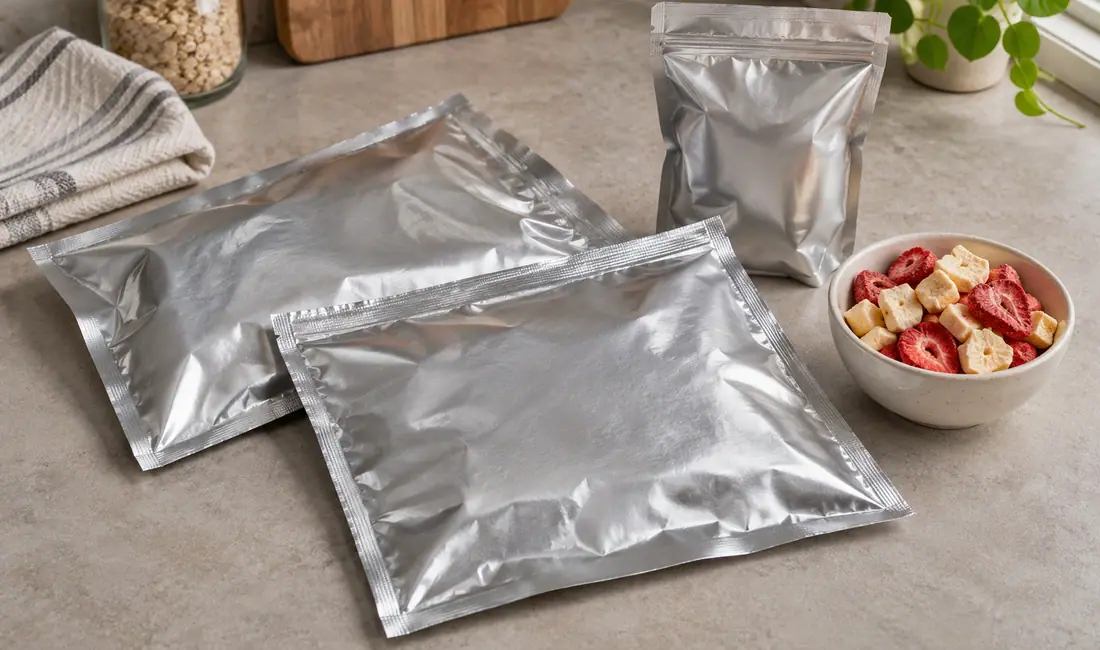
Freeze-drying removes nearly all moisture from food while preserving its shape, color, flavor, and nutritional value. What remains is a light, porous product that absorbs moisture and oxygen from the surrounding air far more readily than fresh or dehydrated alternatives. Storage, then, determines how long that quality actually lasts.
Packaging material, oxygen control, sealing method, and storage environment each play a distinct role, and a weakness in any one of them can shorten shelf life considerably. This guide explains what causes freeze-dried food to degrade, which packaging materials help prevent it, how a reliable storage process works, and how two common packaging methods compare for different storage goals.
Freeze-dried food is a shelf-stable product that has had almost all of its water removed through sublimation, leaving a porous internal structure. That structure absorbs ambient moisture and oxygen quickly, so packaging must actively block air, humidity, light, and heat to preserve quality.
Moisture, oxygen, light, and temperature act on the product in different ways. Each one has its own control measure.
Freeze-drying removes over 95% of the moisture in food. Removing that water makes the dried product highly hygroscopic, meaning it pulls water vapor out of the surrounding air with little resistance.
When moisture is reabsorbed, microbial activity that was halted by dryness becomes possible again, and spoilage risk returns. The relationship is direct: the more water removed, the stronger the product’s tendency to reabsorb it, so packaging must actively block moisture re-entry rather than merely cover the food.
A barrier film with an intact seal is the practical answer. Any gap in that barrier allows humidity to reach the product continuously throughout the storage period.
The porous structure left behind by sublimation creates a much greater air-contact surface area than solid or dense dried foods. Oxygen reaching that surface oxidizes fats and nutrients, changing flavor and lowering nutritional value.
Light adds a second pathway of loss, degrading vitamins and flavor molecules over time. Because more surface area is exposed per unit of product, oxidation and quality loss progress faster in freeze-dried food than in denser preserved foods.
That’s why oxygen and light control are treated as packaging requirements rather than optional extras. Sealed freeze dried fruit with a high fat or vitamin content shows these effects most clearly.
Storage temperature has a measurable effect on how long quality holds. Shelf life roughly halves with each 10°F increase in storage temperature, because higher temperatures accelerate the chemical reaction rates behind oxidation, color change, and nutrient loss.
Cool storage below normal room temperature is therefore preferable for both retail stock and bulk inventory. Warm storage areas shorten usable life, even when packaging remains sealed and undamaged.
Metalized mylar bags combined with oxygen absorbers are the packaging standard for freeze-dried food, because the film blocks oxygen, moisture, and light simultaneously. A heat seal then closes the barrier, while the absorber removes the residual oxygen trapped inside the package.
Film composition, absorber capacity, and seal quality each contribute to the finished package. Secondary containers protect the whole assembly from physical damage.
Metalized polyester film blocks oxygen, moisture, and light at the same time, which is why it forms the base layer of most long-term freeze-dried packaging. Standard polyethylene bags are much more oxygen-permeable, allowing gradual air migration into the package.
Window panels weaken light protection, since the clear section admits the light the metalized layer would otherwise block. Barrier performance is what separates packaging suitable for long-term storage from packaging meant only for short-term handling and quick turnover.
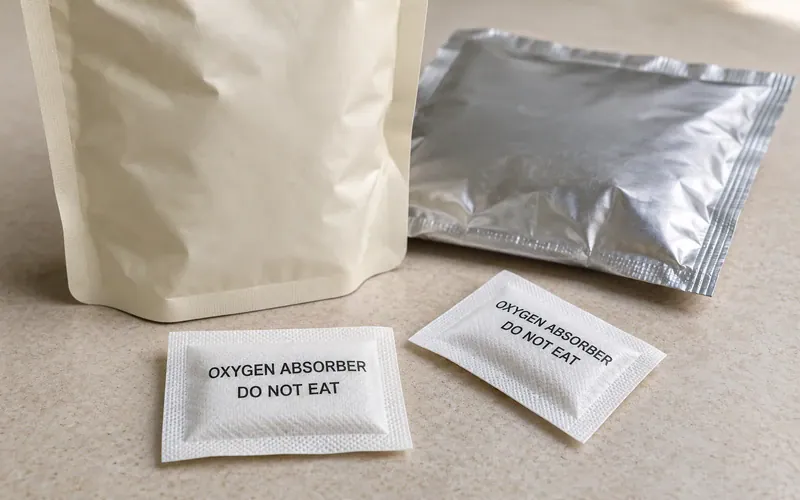
Oxygen absorbers consume residual oxygen inside a sealed package through iron powder oxidation. They begin reacting immediately on exposure to air, so open packets lose capacity while they sit out.
Freeze-dried food’s airy structure requires greater absorber capacity than an equally sized quantity of dehydrated food, because more air voids exist per unit of volume. Absorber sizing should follow package volume, not food weight, since trapped air rather than product mass determines how much oxygen must be removed.
Impulse heat sealers are the standard sealing tool for mylar packaging, producing a consistent seam across the bag opening. Irons or flat irons serve as household alternatives where sealing equipment isn’t available.
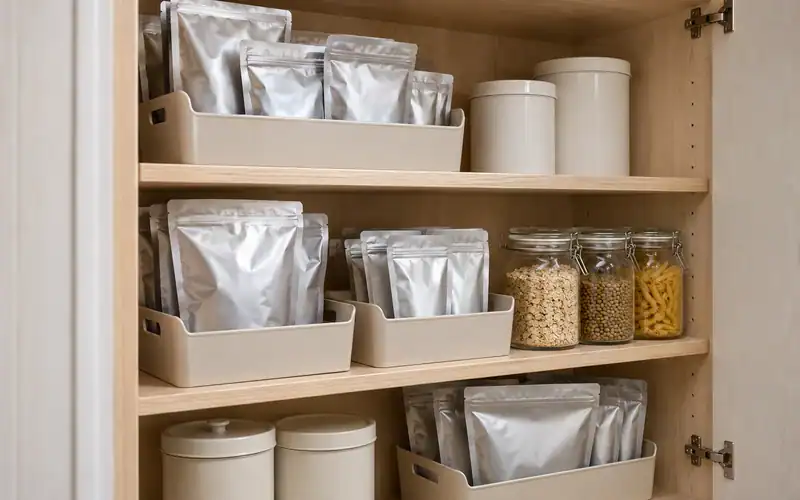
Sealed bags should then be placed in food-grade containers to deter rodents and pests, which can reach the film directly on open shelving. Seal integrity and secondary containment work together: a strong seam protects against air, while the outer container protects the seam from damage.
Correct storage follows a fixed order: confirm the food is completely dry, fill the package while leaving headspace, add a correctly sized oxygen absorber, seal immediately, and verify the seal after one to two days. Skipping any step introduces spoilage risk.
Each step has a check that confirms it was done correctly, from a snap test on the dried pieces to a firmness check on the sealed bag.
Fully dried pieces snap cleanly and feel crisp when broken. Pieces that feel spongy or cool to the touch still retain moisture in the center.
Residual moisture causes spoilage even inside a well-sealed package, because the trapped water redistributes through the product over time. Verifying dryness before sealing is the highest-risk step to skip, since no packaging can correct moisture that was sealed in with the food.
Denser items such as freeze dried pumpkin dices deserve a check on a piece taken from the center of the batch.
Headspace should be left at the top of the bag so the sealing area stays clear of product. The oxygen absorber is added last, immediately before sealing.
Absorbers lose capacity to ambient air once opened, so unused packets should stay closed until the moment they’re needed. Working quickly through filling and sealing preserves the absorber’s usable capacity for the sealed package instead of spending it on room air.
Seals should be made in one smooth pass along the full width of the bag opening. The finished seam needs a check for wrinkles or trapped food particles, both of which create channels for air.
After 24 to 48 hours, a correctly sealed bag feels firm and compressed, because the absorber has removed the internal oxygen and the film has drawn in around the contents. A bag that remains puffy or loose indicates seal failure.
Visual and tactile verification identifies failed seals early enough to repack the product with a fresh absorber, before quality is affected.
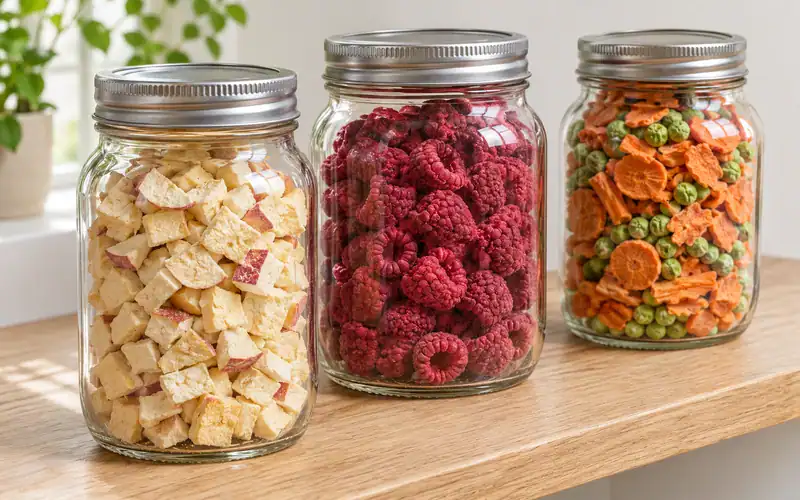
Freeze-dried food keeps best in a cool, dry, dark location with stable temperature and low humidity. Storage areas exposed to heat, sunlight, damp conditions, or pests reduce shelf life even when the packaging itself is correctly sealed and intact.
Location choice covers what packaging cannot: steady temperature, low ambient humidity, darkness, and physical separation from pests.
Cool storage below normal room temperature extends shelf life, since heat accelerates the chemical degradation behind flavor, color, and nutrient loss. Humid environments place continuous pressure on the packaging barrier, because the moisture gradient across the film never eases.
Stable conditions do more for shelf life than the absence of any single short temperature spike. A consistently cool room outperforms a space that swings between cool and warm across seasons.
Light degrades vitamins and causes flavor loss, so dark storage supports the barrier the packaging provides. Opaque packaging outperforms window-panel bags for this reason, since a clear panel admits light directly onto the product.
Rodents and insects can chew through mylar film, which makes location and containment part of the protection plan. Storage location compensates for the physical limits of the packaging itself, keeping sealed bags away from sunlight and pest access points.
Stacked bulk storage introduces puncture risk, as the weight of upper units presses bags against pallet edges, corners, and each other. Distribution and warehousing also involve temperature fluctuation across transit legs and holding facilities.
Commercial-scale storage therefore requires stronger physical and thermal protection than small household batches. FNH provides private label and custom packaging design, and its private label packaging service supports buyers matching package construction to their handling and distribution conditions.
Mylar bag storage provides strong protection against oxygen, moisture, and light, which supports long shelf life when paired with oxygen absorbers. Drawbacks include reduced reliability in freezing conditions, vulnerability to punctures and pests, and the equipment cost required for proper sealing.
The balance between barrier performance, physical durability, and consumable cost decides whether mylar suits a given storage program.
Mylar provides a triple barrier against oxygen, moisture, and light in a single film. Pairing that film with oxygen absorbers extends shelf life substantially, because the absorber clears the oxygen the seal traps inside.
Ordinary sealed bags perform far worse over long periods, since their film admits air gradually. Barrier performance converts directly into storage stability, which is why mylar remains the reference material for long-term dry storage of products such as freeze dried vegetables.
Mylar performs poorly in freezing conditions, where the film becomes less reliable. Pests can chew through the film, so unprotected bags on open shelving remain at risk.
Window-panel designs reduce light protection by exposing part of the contents. These limits require compensation through storage location and secondary containers, which handle the physical and thermal risks the film can’t manage on its own.
Absorbers and heat-sealing equipment add upfront cost to a mylar storage program. Seals also require verification within 24 to 48 hours, which adds a labor step to each packing run.
Different package sizes carry different consumable costs, since absorber capacity and film area both scale with volume. Upfront equipment investment plus these verification steps determine the real long-term cost efficiency of the method.
Mylar bags outperform vacuum-sealed bags for long-term freeze-dried food storage because their metalized layer blocks light and oxygen far more effectively. Vacuum-sealed bags remove air well but use clearer, more permeable film, making them better suited to shorter-term freezer storage.
The two methods differ in film material and in how each removes oxygen. Those two factors set the storage window for each.
Mylar bags use metalized barrier film and rely on oxygen absorbers to clear the air sealed inside the package. Vacuum-sealed bags use clearer plastic film and remove air mechanically by vacuum before the seal closes.
Material and oxygen-removal mechanism together define each method’s core use case, with the metalized film supporting extended shelf storage and the vacuum method supporting shorter cycles.
Mylar is opaque, while vacuum-sealed film is typically transparent, so light reaches the product in the vacuum-sealed format. Vacuum-sealed film also allows gradual oxygen migration over time, meaning the low-oxygen condition created at sealing doesn’t hold indefinitely.
Mylar requires an oxygen absorber to reach a low-oxygen state, while vacuum sealing does not. These barrier differences determine which method fits long-term storage and which works better for shorter-term storage.
| Criterion | Mylar bags | Vacuum-sealed bags |
| Film type | Metalized polyester | Clearer plastic |
| Light barrier | Opaque | Transparent |
| Oxygen removal | Oxygen absorber | Mechanical vacuum |
| Oxygen migration over time | Blocked by metalized layer | Gradual |
| Freezing conditions | Underperforms | Suitable |
| Best storage window | Long-term | Short-term |
Mylar with oxygen absorbers suits room-temperature, long-term storage of freeze-dried food, including bulk stock and freeze dried fast food meal formats. Vacuum-sealed bags suit freezer storage of higher-moisture foods, where mechanically removing the air is sufficient for a shorter holding period.
Mylar underperforms in freezing conditions, so buyers storing at sub-zero temperatures should select the vacuum format. Intended storage duration and environment determine the correct packaging choice.
Opened freeze-dried food begins reabsorbing moisture from the air immediately, so its usable life drops from years to a much shorter window. Resealing the package tightly and keeping it in cool, dry conditions slows the loss of crispness and flavor.
Freeze-dried food doesn’t require freezer storage, since it’s shelf stable at cool room temperature. Mylar packaging underperforms in freezing conditions, so vacuum-sealed film is the better format when freezer storage is chosen.
Signs include moisture inside the package, mold, off odors, and a soft texture in a product that should snap crisply. Damaged packaging, or a bag that stayed puffy after sealing, also indicates the barrier failed and the contents should be discarded.
Sealed freeze-dried meals don’t require refrigeration, because removing moisture prevents microbial growth at room temperature. A cool, dry, dark storage area is sufficient until the package is opened and rehydrated.
Buyers should confirm barrier film construction, seal integrity, absorber sizing relative to package volume, and the supplier’s food-safety certifications. FNH holds ISO 22000, HACCP, FDA, BRC, HALAL, and KOSHER certifications and applies 20 testing stages to maintain stable product quality.
Storing freeze-dried food well comes down to controlling four variables: oxygen, moisture, light, and temperature. Metalized mylar packaging paired with correctly sized oxygen absorbers addresses the first three, while a cool, dry, dark storage location handles the fourth.
Vacuum sealing serves a different purpose and suits shorter-term freezer storage rather than long-term shelf storage. The process matters as much as the material, since residual moisture, a weak seal, or an undersized absorber can undermine otherwise suitable packaging.
For food brands and distributors, packaging quality and supplier certification standards carry the same weight as the product itself. Further details on freeze-dried products and packaging support are available from FNH.