
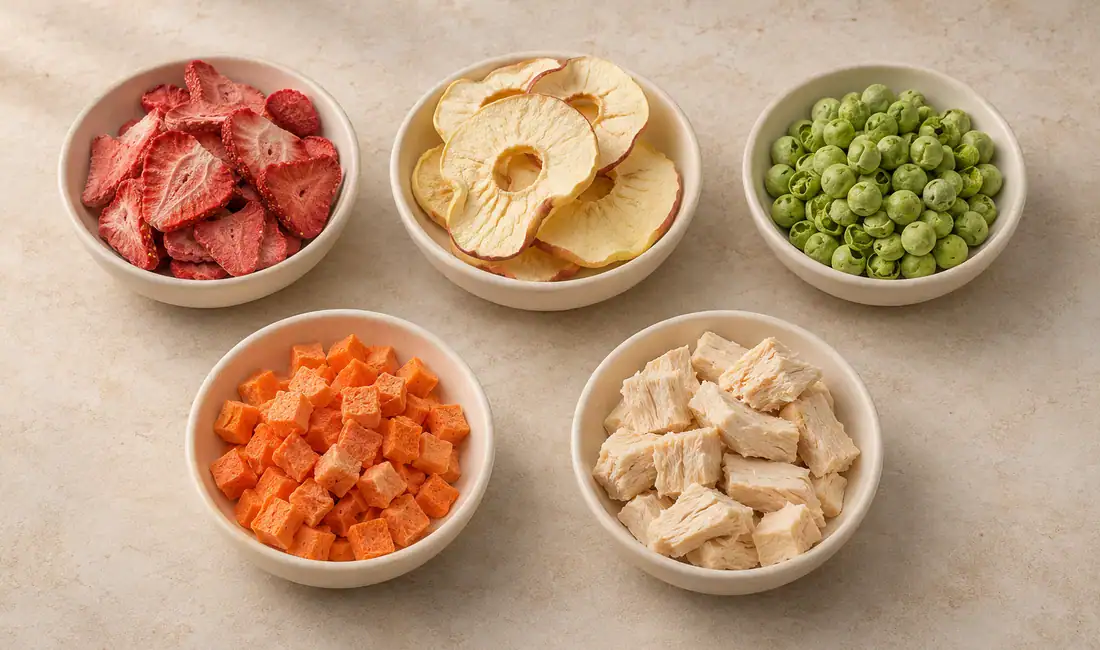
Freeze-dried food and dehydrated food share one goal. Both remove water so the food stays usable for longer. Water is what lets bacteria, yeast, and mold grow. Remove enough of it, and the food becomes far more stable at room temperature.
The two methods are still not the same. Freeze-dried food is made with freezing, vacuum, and sublimation. Dehydrated food is made mainly with heat and moving air. That single difference in method changes the structure of the food, and structure changes almost everything else.
This article compares the two processes across method, texture, nutrition, rehydration, storage, cost, and end use. It is written for brands, buyers, and product developers who need to choose a spec, not for home drying projects.
Freeze-dried food is lighter, more porous, and faster to rehydrate. Dehydrated food is denser, chewier, and cheaper to produce. The table below sets out the main differences at a glance.
| Comparison point | Freeze-dried food | Dehydrated food |
| Drying method | Freezing, vacuum, and sublimation | Warm air, airflow, and evaporation |
| Heat exposure | Low; the food stays frozen while ice turns to vapor | Higher; the food is warmed for hours |
| Final texture | Light, porous, and crisp | Firm, chewy, or leathery |
| Appearance | Close to the original shape and color | Shrunken, and often darker |
| Rehydration | Fast, often 3 to 10 minutes in hot water | Slower; may need soaking or cooking |
| Storage | Very low moisture; needs strong moisture and oxygen barriers | Low moisture; still needs good barrier packaging |
| Weight | Very light, since most water is gone | Light, but usually heavier than freeze-dried |
| Cost | Higher, because of long cycles and vacuum equipment | Lower, because equipment and cycles are simpler |
| Common uses | Instant soups, snack pieces, and cereal inclusions | Dried fruit, dried herbs, and cooking ingredients |
No. Freeze-dried food is not the same as dehydrated food.
In strict technical terms, freeze drying is one type of dehydration. Every drying method removes water, so freeze drying sits inside that wider family. In everyday trade language, though, the two words describe two different processes and two different results. When a buyer asks for “dehydrated” carrot dice, that buyer normally means hot-air dried carrot dice. When the same buyer asks for “freeze-dried” carrot dice, the spec, the price, and the texture all change.
That is why the two terms should never be used as substitutes on a label, a spec sheet, or a purchase order.
Freeze drying removes water from frozen food under vacuum. The food never passes through a wet, warm stage.
The process starts by freezing the food solid. Fast freezing matters here. It creates small ice crystals, and small crystals cause less damage to cell walls. Slow freezing creates large crystals, which tear the structure and soften the final product.
The frozen food then moves into a sealed chamber. A vacuum pump lowers the pressure inside. Low pressure is the key condition, because it allows ice to leave the food as vapor instead of melting into liquid. A condenser inside the system collects that vapor and traps it as ice.
Sublimation is the change from a solid straight to a gas, with no liquid stage in between. In a freeze dryer, the ice inside the food turns directly into water vapor.
This matters for product quality. The food keeps its shape because it dries while it is still frozen and rigid. Water leaves behind tiny open channels, so a freeze-dried strawberry slice stays close to the size of the fresh slice. A second stage, called desorption drying, then removes the small amount of bound water that sublimation leaves behind. Manufacturers run these stages as part of a controlled production line, and FNH sets out its full nine-step freeze-drying process flow for buyers who want to see how each stage fits together.
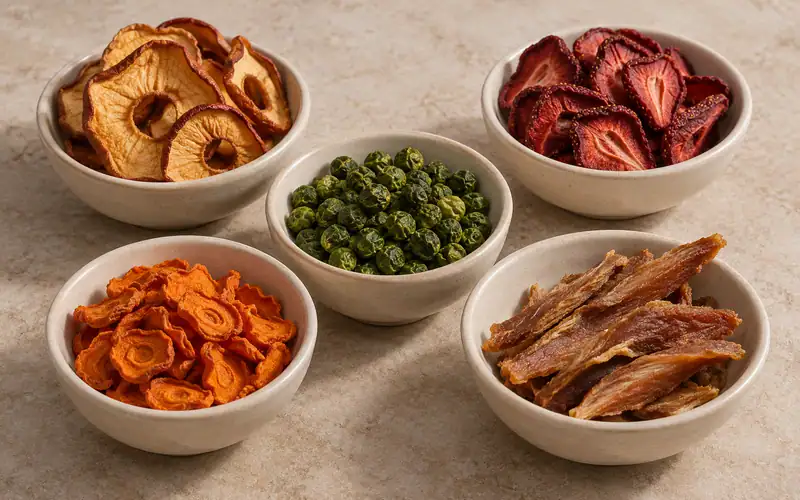
Dehydration removes water by warming the food and blowing air across it. The water leaves as steam from a liquid state.
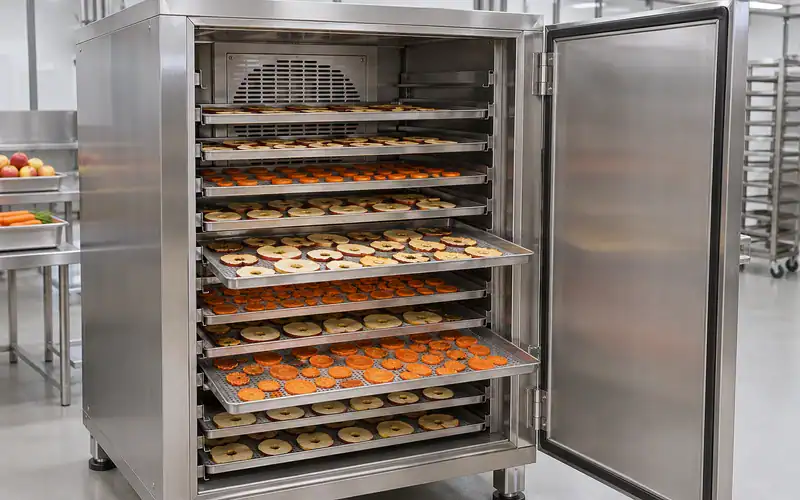
Warm air passes over the surface of the food. That air carries heat in and carries moisture away. Air temperatures for fruits and vegetables often sit between 50°C and 70°C, and the cycle can run for several hours.
Industrial plants use several designs, such as tunnel dryers, belt dryers, and cabinet dryers. Sun drying is still used in some regions for products like tomatoes and chilies. The common factor is simple: heat plus airflow equals evaporation.
Evaporation pulls water out of the cells while the food is soft. The structure collapses inward as this happens, so the pieces shrink. A dehydrated apple ring is much smaller and thinner than the fresh ring it came from.
That collapse gives dehydrated food its familiar character. The pieces are firmer, chewier, or crisper in a hard way. Sugars and acids sit in a smaller volume, so the flavor often tastes more concentrated.
The main difference is the state of the water when it leaves the food. Everything below flows from that point.
Freeze drying uses freezing, vacuum, and sublimation. Dehydration uses heat, airflow, and evaporation.
Heat exposure is the practical gap. In freeze drying, the food stays frozen through the main drying stage, and gentle heat is only applied to drive sublimation forward. In hot-air drying, the food sits in warm air for hours. Longer heat contact affects color, aroma, and heat-sensitive nutrients.
Freeze-dried products usually finish with a very low moisture content, often in the range of 1% to 4%. Hot-air dried products usually finish higher, and many sit between 5% and 20% depending on the item.
These figures are typical ranges, not fixed rules. The real number depends on the raw material, the piece size, the recipe, and the target spec. A dried fruit designed to stay soft will hold more water than a crisp snack piece by design.
The structural result is consistent, though. Freeze-dried pieces are porous and hold their original shape. Dehydrated pieces are dense and clearly smaller than the fresh input.
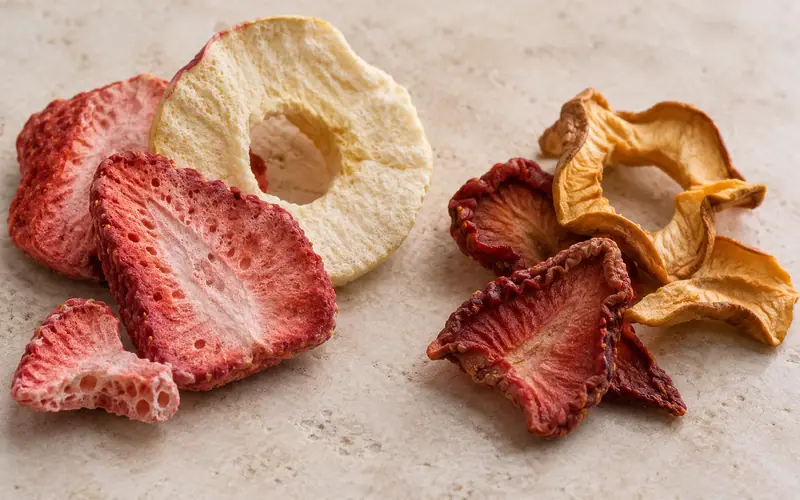
Freeze-dried food is light and crisp, and it breaks with a clean snap. It also keeps color well, since low temperatures slow browning reactions. Freeze-dried fruits, such as strawberries, mangoes, and kiwi, stay bright enough to be used as visible inclusions in cereal and confectionery.
Dehydrated food is denser and chewier. Color often shifts toward brown or amber during drying. Flavor can taste stronger because the same sugars and acids now sit in a smaller piece.
Results always depend on the food type and the process settings. Piece size, sugar content, fat content, and cycle parameters all shape the final outcome.
Both methods change the nutrient profile of the food to some degree. Heat-sensitive nutrients, such as vitamin C, thiamin, and folate, are the most affected by drying temperature and drying time.
Because freeze drying keeps the food cold during the main drying stage, it is generally gentler on these nutrients. That does not mean every freeze-dried product retains the same percentage. Retention varies by crop, variety, harvest maturity, and processing detail.
Minerals and fiber are stable in both processes. Storage also matters after production, since oxygen, light, and warmth slowly reduce sensitive nutrients over shelf life.
Freeze-dried food rehydrates faster. The open pore structure lets water travel back into the piece quickly, and many freeze-dried vegetables return to a usable texture within 3 to 10 minutes in hot water.
Dehydrated food takes longer. The collapsed structure has to open up again, so pieces may need a longer soak or a period of simmering. Some dehydrated ingredients are designed for slow cooking, where that longer time is not a problem.
Not every product needs rehydration at all. Freeze-dried fruit snacks and dehydrated fruit pieces are both eaten dry in many applications.
Lower moisture supports longer storage in both cases. Freeze-dried food starts from a lower moisture level, so it has a strong stability advantage on paper.
Real shelf life is never a property of the drying method alone. It depends on the formula, the residual moisture, the fat content, the barrier strength of the packaging, and the oxygen, light, and temperature in storage. A freeze-dried product in a thin, permeable bag can fail long before a well-packed dehydrated product.
Freeze-dried food is also hygroscopic, which means it pulls in moisture from the air quickly. High-barrier packaging is not optional for these products. Shelf-life claims should always be tied to a defined pack format and defined storage conditions.
Freeze-dried food is usually lighter. Fresh fruits and vegetables often contain 80% to 90% water by weight, and freeze drying removes nearly all of it while keeping the original volume.
That volume is the trade-off. Freeze-dried pieces keep their full size, so a carton holds less weight for the same space. Dehydrated pieces shrink, so they can pack more densely.
For air freight and outdoor products, low weight usually wins. For sea freight of bulk ingredients, packing density can matter just as much.
Freeze drying costs more per kilogram. The process needs freezing capacity, vacuum systems, and condensers, and a single cycle often runs for 20 to 40 hours.
Hot-air drying uses simpler equipment and shorter cycles. That makes it a better fit for high-volume, price-sensitive products where texture change is acceptable.
Buyers should read this as a value decision, not a quality ranking. The right question is whether the end product needs the appearance, the fast rehydration, and the light weight that freeze drying delivers.
Both methods suit different raw materials. The choice usually follows the intended eating experience.
Freeze drying suits products where shape, color, and crispness carry the value. Freeze-dried vegetables, such as corn, bok choy, and shallots, drop into instant soups and ready meals and come back quickly in hot water. Freeze-dried fruit works well as a crisp snack, a topping, and a visible inclusion in bakery and cereal.
Dehydration suits products where a chewy bite or a concentrated flavor is the point. Dried fruit for baking, dried herbs for seasoning blends, and dried vegetable pieces for slow-cooked dishes all fit this profile.
Composition drives the result for these categories. Fat, sugar, salt, and density all change how a food dries and how stable it is afterward.
Fat is the main limit. High-fat items can turn rancid over time, because drying removes water but not oil. Prepared dishes add another layer, since soups, sauces, and mixed meals must survive drying and then rebuild into the right texture with the right amount of water.
For that reason, prepared products are developed recipe by recipe. FNH produces freeze-dried fruits, freeze-dried vegetables, and freeze-dried prepared foods such as instant soups, and each recipe is matched to a target rehydration result rather than a single fixed setting.
Neither method is better overall. Each one is better for a defined set of product goals.
Freeze drying fits products that must look close to fresh, weigh very little, and rehydrate in minutes. It also fits products aimed at long storage in strong packaging.
Typical examples include camping meals, emergency food kits, and instant soup cups. Premium snacks and cereal inclusions also rely on freeze drying, because the color and the clean crunch are part of what the shopper is paying for.
Dehydration fits products with tighter cost targets. It also fits products where a chewy texture or a concentrated flavor is desirable rather than a problem.
Typical examples include dried fruit pieces, dried herbs, and vegetable ingredients for soup bases and seasoning mixes. Compact, shrunken pieces can also lower freight cost per serving.
The decision should start from the finished product, not from the process. Category, sales channel, target retail price, required shelf life, and eating experience all feed into it.
A brand selling a premium snack in a clear pack has different needs from a brand selling a bulk soup ingredient. Some ranges even use both methods in one product, with freeze-dried inclusions for appearance and dehydrated pieces for cost control.
Buyers should confirm the specification, the packaging, and the sample results before placing a bulk order. These three checks prevent most disputes later.
A written spec should cover the ingredient list, the product format, the moisture target, and the microbiological limits. Allergen information and batch documents should be included as well.
Requirements differ by destination market, so the spec should match the rules of the country where the product will be sold. Buyers should also ask which documents travel with each shipment, such as certificates of analysis, batch records, and packing lists.
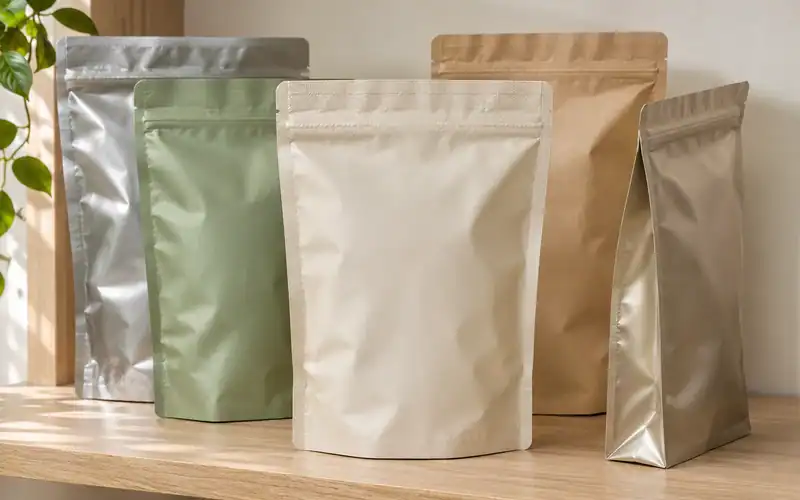
Packaging decides whether the product survives its stated shelf life. Buyers should check the moisture barrier, the oxygen barrier, and the seal method of the proposed pack.
Storage guidance after opening deserves the same attention, especially for freeze-dried items that absorb moisture fast. Any shelf-life statement should be written against a specific pack format and specific storage conditions.
Sample testing should come before volume commitment. A rehydration test in the buyer’s own recipe gives the clearest answer on texture and timing.
Format should be confirmed in writing, since options include whole pieces, slices, dices, flakes, and powders. Commercial terms belong in the same conversation, including minimum order quantity, pack sizes, labeling needs, and any custom packaging work.
Not automatically. Freeze drying is gentler on heat-sensitive nutrients, because the food stays cold through the main drying stage. The final nutrition still depends on the raw material, the recipe, added ingredients, and storage time.
Freeze-dried food usually has the longer potential shelf life, because it finishes at a lower moisture level. That potential is only reached with strong barrier packaging and cool, dry storage. Poor packaging shortens shelf life for either type.
Yes, in many cases. Freeze-dried fruit snacks and dried fruit pieces are both designed to be eaten as they are. Products built around a cooked meal or a soup base still need water to reach the intended texture.
The process takes longer and uses more equipment. A freeze-drying cycle can run for a day or more, and it needs freezing capacity, vacuum systems, and condensers. Hot-air drying uses simpler machines and shorter cycles, so the unit cost is lower.
Freeze-dried and dehydrated foods are two different answers to the same problem. Freeze drying uses freezing, vacuum, and sublimation to give light, porous pieces that keep their shape and rehydrate fast. Dehydration uses heat and airflow to give denser, chewier pieces at a lower production cost.
The right method is the one that matches the product goal. Appearance, rehydration speed, weight, shelf life, and target price should all be settled before the process is chosen. Brands and bulk buyers can review the available freeze-dried food options by category, then request samples and discuss custom formats, packaging, and private label programs with the FNH team.