
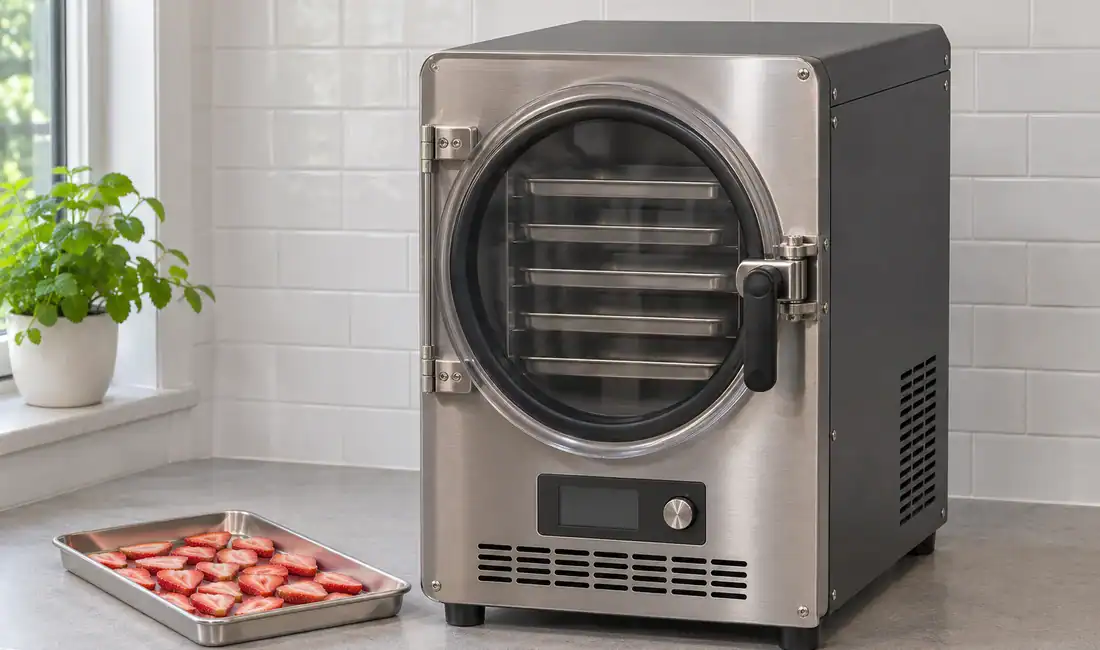
A basket of ripe strawberries can be more than a household can finish. A home freeze dryer offers one way to save that extra fruit. A food brand faces a different task: producing the same food, in the right amount, for repeated customer orders. Both use freeze-drying, but their equipment and daily work differ.
A freeze-dried food machine removes water from frozen food under a vacuum. Home models suit smaller batches, while factory equipment supports larger production plans and more detailed process control. This guide compares their output, costs, and operating needs. It also explains what a food business should consider before making products in-house or buying from a manufacturer.
A freeze-dried food machine, usually called a freeze dryer, combines freezing, low pressure, and controlled heat to remove water from food. It differs from a normal freezer, which keeps food frozen without removing most of its moisture.
The process has three main stages:
The result is a light, dry product that needs suitable packaging to stay dry. Freeze-drying does not remove all fat or sugar, and it does not replace cooking or other food safety steps.
The main differences are batch size, process control, and the work needed to keep production running. Both types use the same basic drying principle. Their features vary by model, so the labels “home” and “factory” are only a starting point.
| Comparison | Home Models | Factory Equipment |
| Main purpose | Household food storage and small trials | Planned food production and repeat orders |
| Batch capacity | Smaller loads, limited by tray space and water load | Larger loads matched to the product and production target |
| Controls | Often automatic cycles; settings vary by model | Commonly supports product-specific cycles and process records |
| Loading and handling | Usually manual preparation and tray loading | May use larger tray systems, carts, and separate preparation areas |
| Installation | Needs a suitable surface, power, ventilation, and pump space | Needs site planning for power, cooling, access, and related equipment |
| Cost focus | Purchase price and cost per household batch | Total production cost, usable output, and order delivery |
Batch capacity must be read with its measurement basis. The weight of fresh food loaded into a machine is different from the weight of finished dry food. Tray area and the amount of water the condenser can capture also limit the load.
For a simple example, a 20 kg load with 80% water contains 4 kg of dry solids. After most of the water is removed, the finished batch weighs much less than 20 kg. This calculation uses an assumed moisture level, not a machine rating.
Weekly output also depends on loading, drying, defrosting, cleaning, and packing time. A machine that holds enough food for one order may still struggle to support several orders each week.
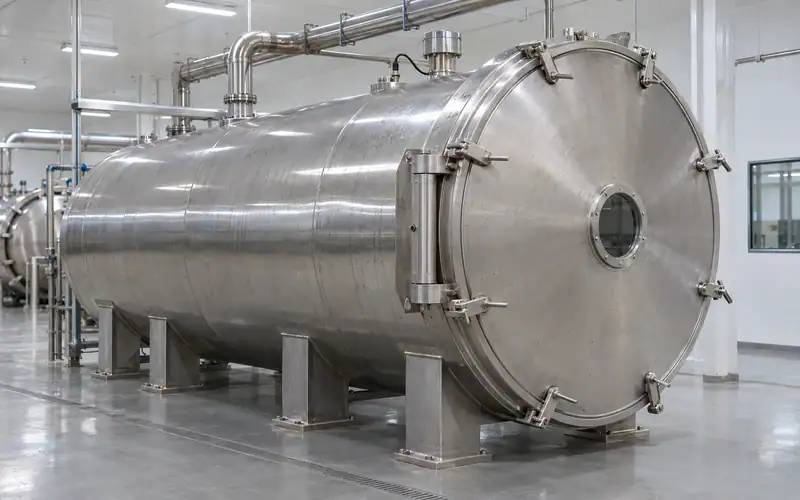
Factory production needs a drying cycle that gives repeatable results for each product. Shelf temperature, chamber pressure, and drying time all affect the outcome. Process records help the team check whether a batch followed the approved settings.
A home machine may offer automatic programs and adjustable settings, but the range of control differs. A successful home batch can show that a product is promising. Its settings still need testing before use on a larger system.
Consistency also includes the food itself. A brand buying freeze-dried fruits may need even slices for snacks or smaller pieces for cereal. Clear size and texture targets help turn a general product idea into a useful production standard.
Home equipment still needs a planned working space. The machine and pump produce heat and noise. The owner must follow the model’s requirements for power, airflow, drainage, and cleaning access.
A factory must also allow for the work around the dryer. Food preparation, tray movement, frozen storage, and packaging need enough space. Power and cooling needs should be checked for the chosen system before installation.
In both settings, the full workflow matters. A drying machine cannot resolve delays caused by slow preparation or a packing area that cannot handle the finished batch.
The purchase price is only part of the cost. Electricity, labor, packaging, pump service, and replacement parts contribute to the cost of each batch. The mix of these costs changes with the machine and local operating conditions.
For a business, a useful measure is total production cost divided by the kilograms of saleable finished food. That total should include a share of equipment and facility costs. It should also allow for failed batches and downtime.
A higher-capacity machine may lower some handling costs when it is well used. However, unused capacity still ties up money. Cost comparisons should use expected orders and tested output, rather than a promise of quick payback.
A home freeze dryer is a good fit when a household regularly has suitable food to preserve and accepts the time and care involved. Common uses include saving garden produce, making lightweight snacks, and storing portions of cooked meals.
The benefit is control over ingredients and batch size. For example, a family can process apples, strawberries, or peas from its own supply. It can also choose portions that fit its normal use.
However, preparing food, cleaning trays, checking dryness, and sealing packages remain manual tasks. Pump maintenance depends on the pump type. A machine with an automatic cycle still needs an owner who follows food handling and storage guidance.
For a food business, small equipment may help with early product trials. It should not be treated as proof that the same recipe will meet larger orders. The business still needs to confirm its process, output, and sales requirements.
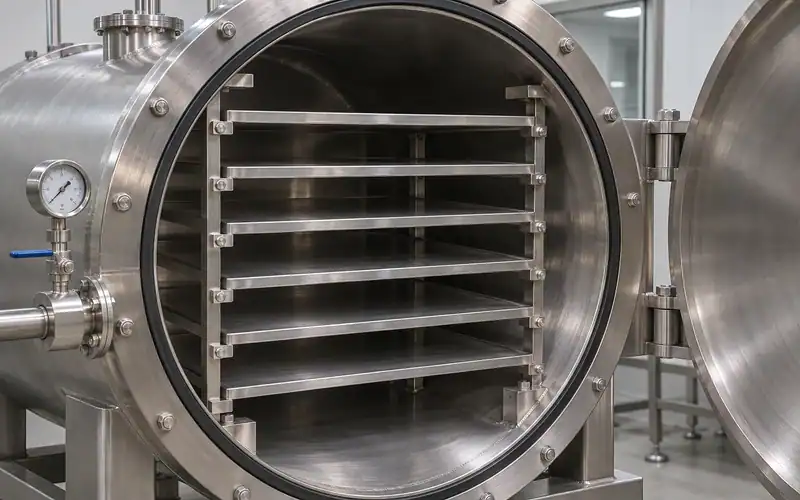
Factory-scale production needs a controlled food process from incoming ingredients to sealed packages. The freeze dryer is one part of that process. Repeat orders depend on consistent preparation, suitable drying cycles, and checks on the finished food.
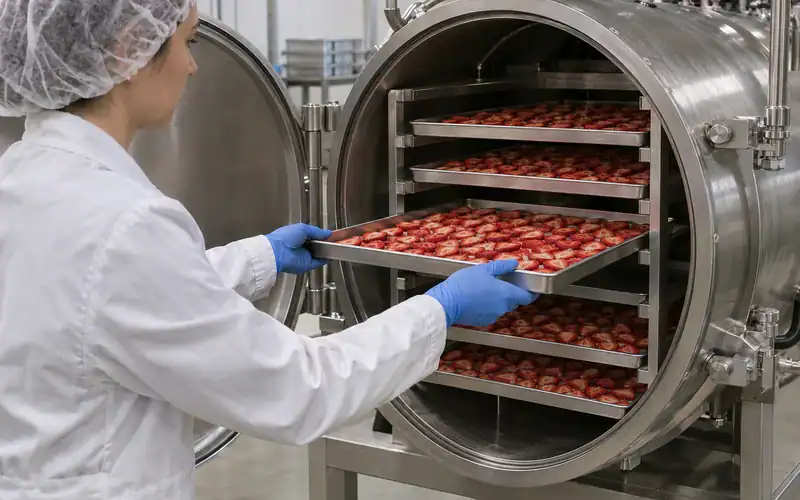
Preparation must match the food and its intended use. Washing, cutting, and cooking may be needed before freezing. Uniform pieces and even tray loads help reduce differences within a batch.
A strawberry slice, a carrot cube, and a portion of prepared soup have different drying needs. Thickness, water content, and the recipe affect how water leaves the food. Manufacturers should test representative loads before setting a routine production cycle.
The aim is to reach the required dryness while keeping the desired structure and texture. Shortening a cycle is useful only if the finished product still meets those targets.
Freeze-drying is not a reliable step for killing harmful bacteria. Safe raw materials, clean equipment, and suitable handling remain essential. Foods that require cooking need an appropriate cooking or other validated safety step.
Manufacturers also need product checks that support their release standards. These may include moisture testing, water activity testing, and relevant microbial tests. The exact plan depends on the food and applicable requirements.
Moisture content measures the amount of water in a food. Water activity describes how available that water is for microbial growth and other reactions. They are related measures, but one does not replace the other.
Batch records link ingredient lots, process settings, and test results. This helps the team review a problem and identify the food affected.
Packaging must protect the dry food from moisture entering again. Depending on the product, it may also need to limit oxygen exposure. Suitable barrier materials and sound seals help protect quality during storage and transport.
After drying, the product should be packed promptly under suitable conditions. A good drying result can be lost if the food sits in humid air or the package seal fails.
Shelf life depends on the food, remaining moisture, packaging, and storage conditions. It should be supported by product-specific evidence. Machine size alone cannot establish how long a food will remain suitable for sale.
In-house production makes sense when a business has enough demand and the resources to manage the full process. Buying finished products may be more practical when the main need is a reliable food supply. The choice should account for both production work and business priorities.
Owning equipment can suit a business with steady orders, suitable space, and a trained team. It may also help when frequent product trials or control over the production schedule are central to the business.
Before investing, the team should confirm actual output with its own food. It also needs a plan for maintenance, quality checks, and production delays. These tasks continue long after the machine arrives.
Buying from a manufacturer can suit a brand that wants to focus on product sales, retail distribution, or recipe development. It reduces the need to build and operate a drying facility, though supplier checks are still necessary.
For example, a soup brand may need freeze-dried vegetables such as carrot, corn, and pea. Its buying specification can define piece size, moisture limits, pack format, and expected order volume.
Buyers should compare samples with that specification. They should also review test documents, minimum order quantities, lead times, and packaging options with the supplier. Clear food specifications make supplier comparisons and sample reviews more useful.
The following questions address common doubts about equipment, food types, and small-scale production.
No. A regular freezer can pre-freeze food, but it cannot run a controlled vacuum freeze-drying cycle. It lacks the vacuum and vapor-capture system used by a freeze dryer. Freezer burn is not a substitute for controlled freeze-drying.
It may be possible, depending on local rules, the food type, and the production setup. Some small food businesses use compact machines. Owning one does not establish that the premises or products meet sales requirements. The business must check those requirements before selling.
No. A larger machine usually holds more food, but batch time depends on product thickness, loading, heat transfer, and system performance. It may deliver more food over a week without finishing each batch sooner. Comparisons should use the same product and a clearly defined load.
Very oily foods and some high-sugar foods can be difficult to process. Pure oil contains no water for the machine to remove. Syrups and sweet mixtures may need special preparation or cycles to avoid sticky or collapsed products. Mixed foods should be tested as complete recipes.
A home freeze dryer suits smaller preservation tasks when the owner can manage preparation, drying checks, and packing. Factory equipment supports larger production needs, alongside tested processes and quality controls. In either case, useful output matters more than the machine’s label.
For food brands, the decision should start with the required product, order volume, and delivery plan. FNH Food supplies freeze-dried fruits, vegetables, and prepared foods. Brands can share their product requirements with FNH Food to discuss suitable food options and packaging needs.