
Freeze-drying removes almost all water from food while keeping its shape and cell structure largely intact. What remains is a porous product that absorbs liquid quickly once water is reintroduced. Rehydration is the step that restores that water, and the result depends on three variables: how much water is added, what temperature it is, and how long the food is left to absorb it. Different foods respond differently, so a single fixed method rarely suits every product. This guide explains why absorption rates vary, how water ratio and temperature affect the final texture, how hot and cold rehydration compare, and what separates precooked freeze-dried products from raw ones.
Freeze-dried food is a porous product whose internal structure remains largely intact after sublimation removes its water. The empty spaces left behind draw liquid in rapidly by capillary action, which is why most items absorb water within minutes rather than requiring long soaking.
Absorption speed is driven by three physical factors: density, piece size, and water temperature. Buyers who understand those factors can predict how a product will behave in a kitchen, a production line, or a retail pack.
During freeze drying, ice inside the food turns straight into vapour. The solid parts of the food stay in place, so the finished piece keeps its original outline with air pockets where ice used to be. That open network is often called a porous matrix.
Rapid freezing before the drying stage keeps ice crystals small. Small crystals leave fine, even pores, which rehydrate uniformly. Large crystals tear cell walls and produce patchy absorption and soft spots after water is added. This is why freezing speed is treated as a critical control point in a freeze dryer operation.
Thin, low-density pieces take on water fastest. Dense, thick pieces take longest.
| Food type | Typical rehydration time |
| Leafy greens, herbs | About 2 minutes |
| Freeze-dried fruit slices, berries | 5 to 10 minutes |
| Freeze-dried vegetables (dices, peas, corn) | 5 to 15 minutes |
| Cooked meat pieces, dense proteins | Up to 40 minutes |
Piece size explains much of the spread. A 6 mm dice absorbs water far faster than a 15 mm chunk of the same vegetable, which is why uniform cutting is a sourcing specification, not a cosmetic detail. FNH supplies freeze dried vegetables in whole pieces, slices, chunks, dices, granules, and powders so buyers can match format to the required soak time.
The same porosity that makes rehydration fast also makes freeze-dried ingredients sensitive to humid air. An opened bag left uncovered pulls moisture from the room, and pieces lose their crisp snap within hours.
Partial moisture pickup damages texture before cooking even starts. Storage in sealed, moisture-barrier packaging with the air removed protects both crispness and rehydration performance.
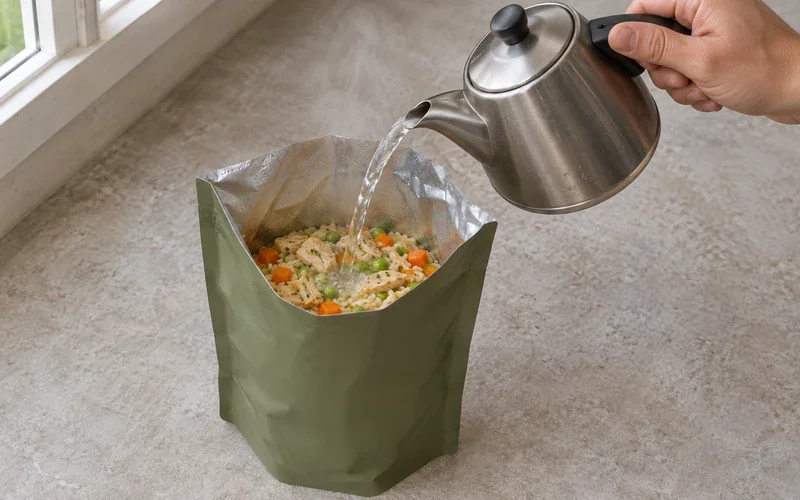
General industry guidance places most freeze-dried food between a one-to-one and two-to-one water-to-food ratio by volume, with denser meals and powders needing the higher end. Package instructions take precedence, since ratios vary by product and preparation method.
Water volume controls whether the finished product is firm, soft, or waterlogged. The safest working method is to start low and correct upward.
These ranges apply by volume, measured before water is added:
Grains and pasta expand well beyond their dry volume, so the container should be sized for the finished portion.
Adding all the water at once is the most common cause of a soupy result. Pouring in roughly three-quarters of the target volume, stirring, waiting, then topping up gives a correctable process.
Under-hydrated food is easy to fix with another spoonful of water. Over-hydrated food requires draining, uncovered resting, or a short sauté to drive off moisture, and the texture rarely returns to where it should be.
Complete meals contain mixed densities in one pack. Rice, meat, and vegetables absorb at different rates, so these products need the higher ratio plus a stir partway through to move water toward the slowest pieces.
Powders behave differently again. A freeze-dried fruit or vegetable powder disperses into liquid rather than swelling, so it is dosed as a percentage of the recipe. Whisking the powder into a small amount of liquid first prevents lumps before the rest is added.
Warm to hot water speeds absorption and suits meats and complete meals, while cool or room-temperature water gives better control over delicate items. Most foods need several minutes to around fifteen minutes, with stirring partway through to even out moisture.
Temperature changes both the speed of uptake and the firmness of the finished piece. Time then does the rest of the work.
Hot water moves into the porous structure faster and softens plant cell walls at the same time. That helps meats and starches, and it can push delicate fruit past pleasant firmness into mush.
| Water temperature | Best suited to | Effect |
| Boiling / near boiling | Stews, soups, pasta, rice, meat, eggs | Fastest, softest result |
| Hot (not boiling) | Peas, corn, green beans, oatmeal | Fast with texture retained |
| Warm | Most vegetable dices | Balanced speed and bite |
| Cool / room temperature | Freeze-dried fruit, yoghurt pieces, herbs | Slowest, firmest, most control |
Boiling water applied directly to fine slices of freeze dried fruit breaks down structure quickly, so cooler water is the standard choice for fruit that needs to hold its shape in a bowl or on a dessert.
Leafy greens finish in about 2 minutes. Fruit and vegetables sit between 5 and 15 minutes. Dense cooked meat can take up to 40 minutes in hot water, and raw meat in cold water may need several hours or an overnight rest in refrigeration.
Covering the bowl or pouch keeps heat in and shortens the wait. A stir at the halfway point redistributes liquid and prevents dry pockets at the base of the container.
A test piece taken from the centre of the batch is the practical check. Cutting it open shows whether the middle is still dry, chalky, or lighter in colour than the outside.
Other signals include a crunchy core inside a soft exterior, pieces floating on top of the water without sinking, and free water sitting in the bowl while the food stays firm. Each of these calls for more time, a stir, or slightly warmer water.
Rehydrated freeze-dried food generally resembles cooked rather than fresh food, since the original cell structure has been dried and refilled with water. Flavor, color, and aroma are largely retained, making the result well suited to soups, baked goods, and prepared dishes.
Texture expectations should be set before a product is specified for a menu or a retail line. Flavour and colour performance, by contrast, remain close to the original material.
Rehydrated peas, corn, and diced carrot come back close to their cooked state, with a soft bite and full shape. Meat returns to the texture of cooked meat, tender at the edges and firmer in the middle if soak time is short.
Fruit behaves less predictably. Berries and sliced fruit soften and hold moisture well, yet the crisp snap of fresh fruit does not return. Products used in soups and stews benefit from this, since the softened texture blends into the dish.
Freeze drying works at low temperature, so heat-sensitive aroma compounds survive the process better than in hot-air drying. Colour stays close to the original, which is why freeze-dried strawberry pieces keep a bright red in a finished bakery product.
Flavour concentrates in the dry state and returns to normal intensity once water is added. Rehydrating in broth, stock, or milk carries additional flavour into the porous structure, a useful technique for foodservice preparation.
Repeatable rehydration begins in the plant. Freezing rate, uniform piece size, consistent slice thickness, and controlled final moisture all decide how a batch behaves in the kitchen.
FNH uses 20 testing stages to maintain stable product quality, including microbiological testing for total aerobic plate count, E. coli, and Salmonella species, along with taste-panel and sensory evaluations at stages of production. For buyers, requesting the cut specification and a sample soak test is the practical way to confirm that batches will perform the same way each time.
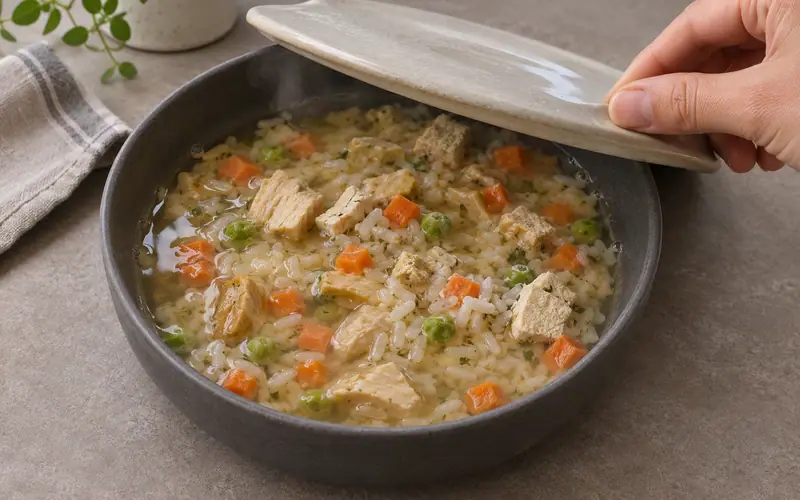
Preparation varies by category. Fruits and thin vegetables absorb water quickly and can often be eaten dry, meats need warmth and time to reach the center, and precooked soups and meals are designed to be rehydrated directly before serving.
Matching method to category avoids the two common failures: mushy fruit and cold, hard centres in protein.
Freeze-dried fruits work well without any water at all in cereals, snack mixes, and bakery toppings. When softening is wanted, cool water for 5 to 10 minutes gives fruit that holds its shape.
Vegetables split by density:
Adding freeze dried vegetables directly into a soup or stew removes the separate soak step. The recipe liquid should be increased by roughly one cup for each cup of dry ingredient to cover what the pieces absorb during cooking.
Freeze dried meat needs both heat and patience. Cooked meat pieces take 20 to 40 minutes in hot water, and the pieces should stay fully submerged for the entire soak.
The centre check is the control step. A piece cut from the middle of the batch should be soft throughout with no dry core. Freeze-dried raw meat must be cooked after rehydration to a safe internal temperature, verified with a probe thermometer rather than by appearance.
Precooked items, including freeze-dried soups and complete meals, are ready to eat once water is added and the soak time has passed. No further cooking is required, though a short simmer improves texture in rice and pasta dishes.
Raw products are a different category. Raw meat, raw egg, and raw dough ingredients return to their raw state after water is added and carry the same handling rules as fresh raw food. Product labels state which category applies, and buyers should confirm the product state on the specification sheet before writing preparation instructions.
Rehydration restores freeze-dried food to a usable state within minutes while retaining flavor, color, and aroma. Limitations include texture closer to cooked than fresh food, sensitivity to excess water and high heat, and the loss of shelf stability once liquid is added.
Both sides of that balance affect menu design, portion control, and kitchen workflow.
Speed is the clearest benefit. Complete meals reach serving condition in 10 to 15 minutes with no chopping, thawing, or trimming, which cuts labour in foodservice and catering settings.
Other operational gains include:
Excess water is difficult to reverse. Once a batch is waterlogged, draining removes flavour along with the liquid, and the texture stays soft.
High heat applied to delicate items causes collapse. Fine fruit slices and leafy greens lose structure in boiling water. Rehydration also takes real time for dense proteins, which needs to be built into service timing rather than treated as instant.
Shelf stability ends the moment water is added. Rehydrated food is treated as fresh, perishable food from that point and follows normal food safety rules for holding temperature and time.
Dry product should stay sealed between uses. Resealing bags, using desiccant where supplied, and keeping stock away from steam and heat sources protect the porous structure until the product is needed.
Hot water rehydration is faster and suits meats and complete meals, while cold water works more slowly but gives greater control over texture and is preferred for fruits and heat-sensitive items. Neither method is universally better; the food type decides.
Both methods reach full rehydration. The difference lies in speed, texture control, and whether a heat source is available.
Hot rehydration uses water between hot tap temperature and boiling. It drives liquid into the porous structure quickly and softens cell walls at the same time, which is what dense proteins and starches need.
Cold rehydration, sometimes called cold soaking, uses room-temperature or chilled water over a longer period. It requires no stove or fuel and is the standard approach where heat is unavailable or where firm texture is the goal.
| Criteria | Hot water | Cold water |
| Speed | 5 to 15 minutes | 30 minutes to overnight |
| Texture result | Softer, cooked-like | Firmer, more defined |
| Best for | Freeze-dried meat, complete meals, rice, soups | Freeze-dried fruit, yoghurt pieces, herbs |
| Heat source needed | Yes | No |
| Risk | Collapse of delicate pieces | Dry centres if rushed |
Hot water is the correct choice whenever the product contains protein, rice, pasta, or a mixed complete meal. Those items need both moisture and warmth to reach an acceptable centre.
Cold water suits fruit destined for desserts, yoghurt, or garnish work, where a defined edge is wanted. Warm water sits between the two and handles most vegetable dices well. Kitchens running both methods should record the water temperature and soak time that produced the best result for each product code, then reuse those settings for consistency.
Freeze-dried fruits, berries, vegetable crisps, and many snack formats are ready to eat straight from the pack. Their crisp texture is a feature in cereals, trail mixes, and bakery toppings. Precooked meals and dense proteins require water before serving.
Broth, stock, milk, and fruit juice all work in place of water and carry extra flavour into the porous structure. Thicker liquids such as milk absorb slightly more slowly, so a few additional minutes may be needed. The same volume ratios apply.
Shelf stability ends once liquid is added, and the product becomes perishable. Rehydrated food should be treated like any fresh prepared dish: held hot above safe holding temperature, or refrigerated and used within a day or two, following local food safety rules.
Hard centres come from short soak times, water that is too cool, or pieces that were not fully submerged. Dense cooked meat can need up to 40 minutes in hot water. A test piece cut from the middle of the batch confirms whether the centre is done.
Buyers should run a sample soak using the intended water ratio, temperature, and time, then cut test pieces to check the centre. Recording results in a batch log across several lots reveals whether piece size and drying control are consistent, which is what makes rehydration repeatable in production.
Rehydration comes down to three controllable variables: water volume, water temperature, and time. General ratios and timings offer a useful starting point, but food type determines the result, so package instructions and gradual water addition remain the most reliable approach. Hot water suits meats and complete meals, while cool water gives better control over fruits and heat-sensitive items. Texture after rehydration is closer to cooked than fresh food, and that expectation shapes how each product is best used. For food brands and foodservice buyers, consistent rehydration reflects upstream manufacturing control as much as preparation technique. Further details on available freeze-dried products are available from FNH.